

Freeze thaw concrete damage begins when moisture inside or along the surface of concrete freezes, expands, thaws, and then enters the material again.
One cold night does not automatically ruin a driveway, but repeated cycles can gradually enlarge existing weaknesses, loosen the surface paste, open cracks, and expose areas where drainage or installation conditions are already working against the slab.
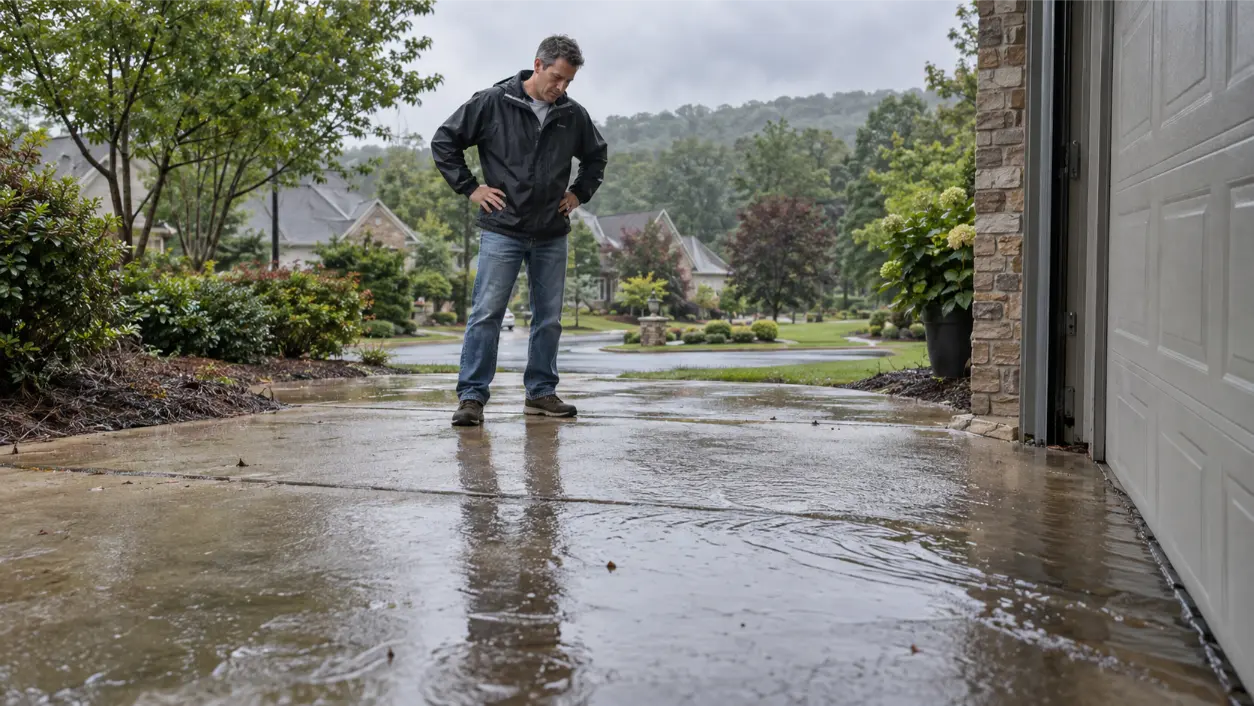
For North Georgia homeowners, the important issue is not whether the region experiences a long northern winter. It is whether wet concrete is repeatedly exposed to temperatures that move above and below freezing. A rainy period followed by a cold snap can be enough to reveal vulnerable joints, saturated edges, shallow surface defects, or cracks that have been collecting water.
Why Moisture Matters More Than Cold Alone
Concrete contains a network of pores and tiny pathways. When those spaces are relatively dry, freezing temperatures have less water to act on. When the concrete becomes highly saturated, freezing water creates internal pressure. Properly designed air-entrained concrete includes microscopic air spaces that give freezing water room to expand, helping the material resist repeated cycles.
The greatest risk is therefore a combination of moisture, freezing, repeated cycling, and a concrete surface or mixture that cannot relieve the pressure effectively. Poor drainage, cracks, open joints, low spots, snow or ice melt, and frequent wetting can all keep portions of a driveway closer to saturation.
What a Freeze-Thaw Cycle Does Inside Concrete
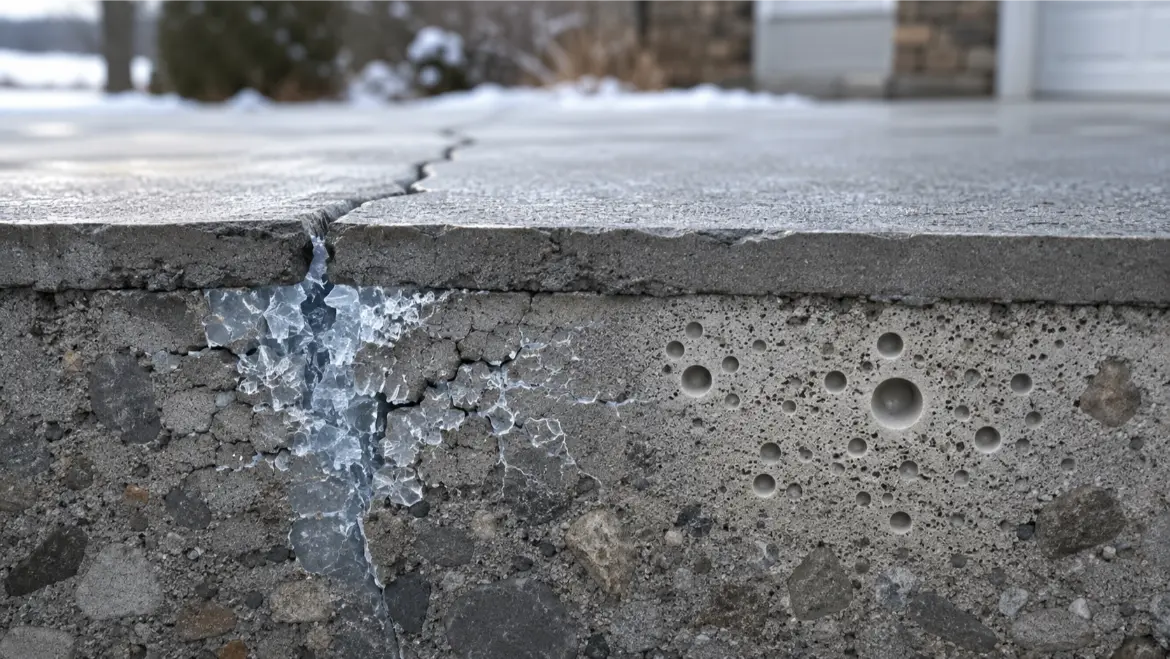
A freeze-thaw cycle is not simply a slab becoming cold and then warming again. Water within the pore structure begins to freeze, and the resulting movement places stress on the surrounding cement paste. When temperatures rise, the ice melts. New water may enter before the next freeze, allowing the process to repeat.
Over many cycles, vulnerable concrete may develop internal microcracking. Those small internal changes are not always visible immediately. Surface scaling, flaking, spalling, map-like cracking, or deterioration near joints and free edges may appear later, especially where moisture has been available repeatedly.
Surface Scaling: Why Concrete Flakes After Cold Weather
Surface scaling is the local flaking or peeling of hardened concrete. It often begins as small, shallow patches. As deterioration progresses, patches may merge, expose sand and coarse aggregate, and leave the surface rough or pitted.
Cold weather may be the event that makes scaling noticeable, but the visible damage can reflect several contributing conditions: a weak surface layer, excessive water at the surface during finishing, inadequate curing, insufficient air entrainment for the exposure, repeated saturation, or the use of deicing chemicals. This is why two driveways on the same street can respond differently to the same cold spell.
Existing Cracks Can Become Water Pathways
A crack gives water a direct route into the slab and toward the base beneath it. When that water freezes, pressure can affect the crack edges and nearby paste. Thawing may allow more water and debris to enter. The crack can then widen, branch, or begin losing material along its edges.
Not every crack expands during winter, and crack width alone does not diagnose the cause. Pay attention to change: new branching, crumbling edges, vertical displacement, water emerging from the crack, or a crack that is measurably wider after repeated weather events.
Joints and Driveway Edges Often Show Damage First
Joints, slab edges, garage transitions, and low areas are common places to find early freeze-thaw distress because they can collect moisture and have more exposed surface. A deteriorated joint may begin to spall along the edges. An unsupported driveway border can also hold water beside the slab while vehicle loads stress the same area.
Inspect the driveway where it meets the street, garage, lawn, drain, culvert, or retaining edge. These transitions can reveal drainage and support issues before the center of the driveway shows obvious deterioration.
Deicing Products Can Increase Surface Stress
Deicing chemicals can contribute to scaling and joint deterioration, particularly when concrete is young, highly saturated, poorly finished, or repeatedly exposed. They may keep the surface wet, increase the number of freeze-thaw events at the surface, or interact with the concrete in ways that accelerate distress.
Homeowners should follow product instructions and avoid assuming that every ice-melting product is equally suitable for every concrete surface. Mechanical snow or slush removal and improving drainage can reduce the amount of meltwater that remains on the driveway. Sand can improve traction without acting as a deicer, although it still needs to be swept away later.
Why North Georgia Driveways Can Still Be Affected
North Georgia winters are variable. A driveway may experience rain, overnight freezing, daytime thawing, and another freeze within a short period. Shaded areas, higher elevations, north-facing slopes, and low spots may remain colder or wetter than the rest of the property.
The number of cycles at a specific driveway can matter more than the seasonal average. Concrete beside a downspout or in a shaded drainage path may freeze repeatedly while a sunny, well-drained section nearby stays relatively dry.
Signs of Moisture Inside or Around the Concrete
- Dark areas that remain damp after the rest of the driveway dries.
- Water entering cracks or open joints during rain.
- New scaling or flaking concentrated in a low area.
- White deposits, staining, or dampness along crack edges.
- Water pooling at the garage apron, curb, or lawn-side edge.
- Loose surface mortar or small chips appearing after cold weather.
- Repeated icing in the same location even when most of the driveway is clear.
- Water or fine material pumping from a joint under vehicle loads.
How to Tell Minor Surface Wear From a Larger Problem
A small area of shallow scaling may remain primarily a surface condition. Concern increases when deterioration is widespread, deep enough to expose aggregate, accompanied by cracking or settlement, or expanding after each wet-cold period.
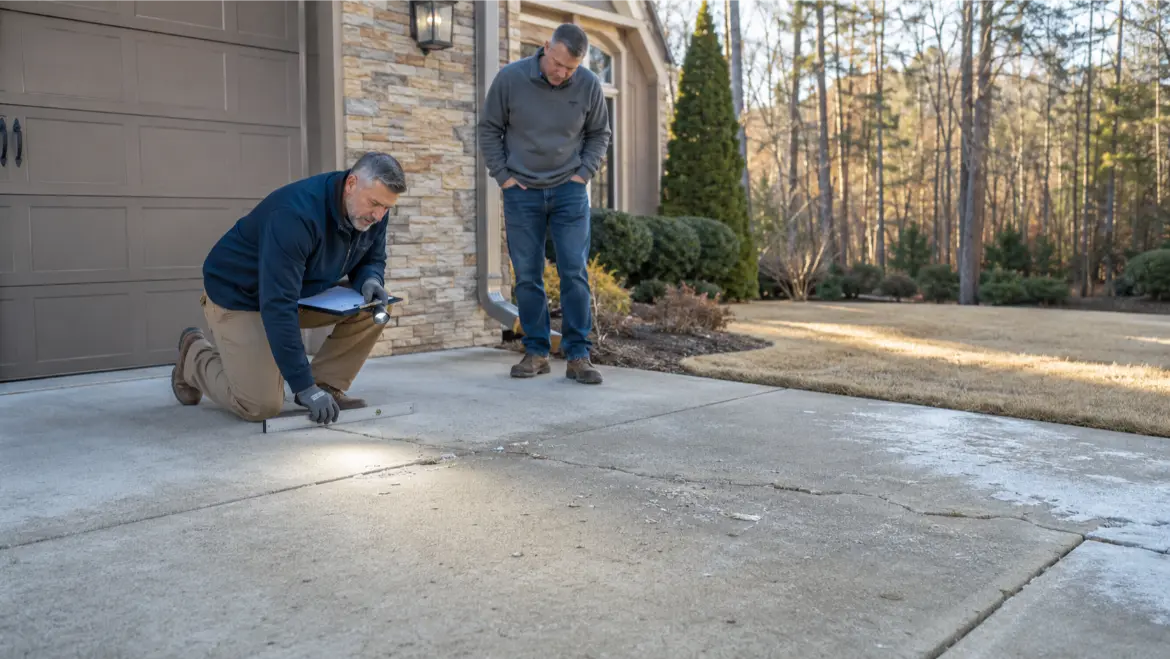
Look at the whole driveway rather than one flake. A professional evaluation becomes more useful when multiple slabs are affected, the surface sounds hollow, cracks are moving, edges are crumbling, water is reaching the garage, or the driveway is becoming uneven. Gold City Construction lists large cracks, widespread surface damage, sinking concrete, drainage problems, and crumbling areas among the conditions that may make replacement a practical long-term option on its concrete driveway services page.
What Homeowners Can Do After a Cold Spell
- Photograph any new flaking, cracks, or chipped joint edges.
- Sweep away loose material so you can see whether new pieces appear.
- Mark the limits of the affected area with removable chalk.
- Check the area during rain and record where water enters or pools.
- Compare crack width and slab height at the same points over time.
- Redirect downspout discharge away from the driveway when it can be done safely.
- Avoid concentrated heavy loads on visibly weak edges or settled areas.
- Request an evaluation if deterioration continues or affects safety, drainage, or access.
Prevention Starts With Design, Placement, and Drainage
Durable exterior concrete depends on more than the material at the surface. The concrete mixture, air-void system, water-cement ratio, finishing, curing, base preparation, joint layout, slope, drainage, and timing of exposure all influence performance.
For an existing driveway, homeowners cannot change the original mixture, but they can reduce repeated saturation. Keep drainage paths open, correct concentrated runoff, avoid leaving piles of wet leaves or debris in low areas, and monitor cracks and joints. A penetrating sealer may be appropriate in some situations, but product selection, surface condition, preparation, and timing matter; a sealer cannot restore failed support or reverse advanced deterioration.
When Replacement May Be More Practical Than a Surface Repair
A cosmetic treatment cannot correct a driveway with widespread scaling, deep spalling, unstable slabs, drainage failure, or extensive cracking. Repairs may also look and perform differently from the surrounding aged concrete. The practical choice depends on the affected area, depth of deterioration, support conditions, layout, and the homeowner’s goals.
Gold City Construction currently focuses on new driveway installation, driveway replacement, extensions, and residential flatwork. Homeowners can review completed exterior and concrete projects to understand the type of work the company performs, while recognizing that an on-site assessment is needed to determine a suitable scope for a particular property.
How Gold City Construction Helps North Georgia Homeowners
Gold City Construction provides residential concrete driveway installation, replacement, extensions, and flatwork across North Georgia and North Atlanta communities. Its process begins with an on-site review of existing conditions, measurements, drainage, access needs, layout, and homeowner goals.
When flaking, cracking, drainage problems, or uneven sections are affecting the function or appearance of a driveway, homeowners can request a free on-site estimate to discuss whether a replacement or redesigned concrete layout may be appropriate. An estimate does not mean that every surface defect requires replacement; it provides an opportunity to review the property and practical project options.
Frequently Asked Questions
Can one night below freezing damage a concrete driveway?
One cold night does not automatically cause visible damage. Risk increases when concrete is wet or highly saturated, has vulnerable surface conditions, and experiences repeated freezing and thawing. A single cold spell may reveal deterioration that developed from several contributing factors.
Why does concrete flake after cold weather?
Flaking may be surface scaling associated with freezing and thawing, moisture saturation, deicing chemicals, a weak surface layer, or inadequate curing and finishing. The pattern, depth, location, and progression help identify whether the problem is localized or widespread.
Can freezing weather widen driveway cracks?
Water entering a crack can freeze and place stress on its edges. Repeated cycles may contribute to widening or edge breakdown, but settlement, soil movement, loads, and joint design can also affect a crack. Monitor measurable change rather than assuming temperature is the only cause.
Does all scaled concrete need to be replaced?
No. Light, localized scaling may be evaluated differently from deep or widespread deterioration. Replacement becomes more likely when the damage affects large areas, exposes aggregate deeply, accompanies settlement or cracking, or creates drainage and safety problems.
Should I seal my driveway before winter?
A suitable penetrating sealer may help reduce water absorption in some concrete, but it must be compatible with the surface and applied according to the manufacturer’s requirements. Sealing does not repair structural movement, poor drainage, lost support, or advanced scaling.
When should I ask a contractor to inspect the driveway?
Request an evaluation when flaking continues to spread, cracks widen, joints spall, aggregate becomes exposed, slabs become uneven, or water repeatedly pools or freezes in the same location.
This article provides general homeowner education and is not an engineering assessment. Sudden movement, severe deterioration, suspected structural impact, or conditions affecting a building may require review by a qualified engineer or other appropriate professional.
RELATED LINK: American Concrete Institute – Resistance to Cycles of Freezing and Thawing