

The most common sinking driveway causes are usually below or beside the slab rather than on its visible surface.
Uneven soil compaction, erosion from runoff, lost edge support, disturbed fill, tree roots, and repeated heavy vehicle loads can all cause one wheel path or driveway edge to settle lower than the rest. The pattern matters because a slab that drops beside the lawn may have a different cause from concrete settling at the garage entrance.
A sinking section is not only a cosmetic concern. It can redirect water, create a trip point, make vehicles scrape, place stress on nearby slabs, and allow the movement to continue. Understanding the likely site conditions helps a homeowner decide what to monitor, what to correct immediately, and when to request an on-site evaluation.
What Driveway Settlement Actually Means
Concrete performs best when the ground beneath it provides uniform support. If one area compresses, washes away, shrinks, or loses confinement, the slab can settle into the weakened space. The result may be a smooth downward tilt, a visible step at a joint or crack, a low wheel path, or an edge that drops toward the lawn.
The concrete itself may still be relatively intact. In many cases, the visible slab is responding to conditions in the subgrade, aggregate base, drainage path, or surrounding soil. That is why a surface patch alone may not stop the movement.
Cause 1: Soil Was Not Compacted Evenly
A driveway depends on properly prepared and compacted material beneath the slab. If fill soil or aggregate was placed in thick lifts, compacted inconsistently, or built over an area that had already been disturbed, one section can compress more than another over time.
Uneven compaction often becomes noticeable after several seasons of rain, drying, and traffic. The driveway may initially look level, then one wheel path begins to dip or a joint develops a height difference. Settlement near a new home, an addition, a widened driveway, or a replaced utility line can sometimes relate to disturbed soil that was not restored uniformly.
Cause 2: Water Is Eroding Support Below the Slab
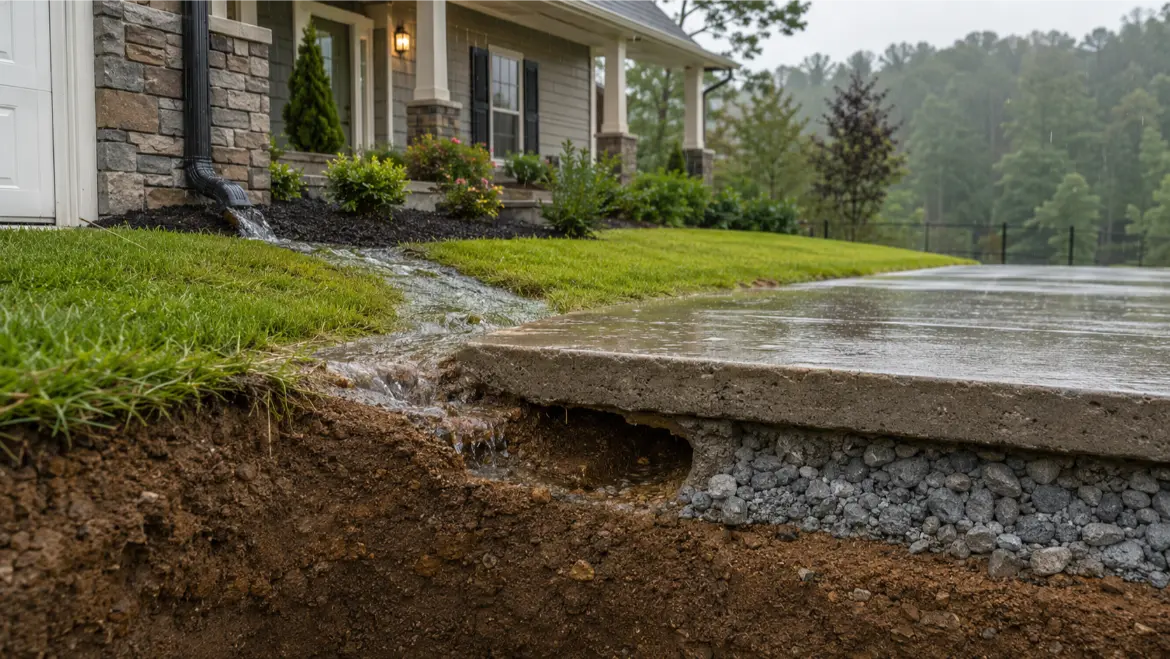
Water is one of the most important clues in driveway settlement. Runoff from a roof, downspout, slope, lawn, or neighboring hard surface can move along the driveway edge or enter cracks and joints. If that flow carries fine soil away, a void can form beneath the slab.
Repeated vehicle loading can worsen the condition when water and loose material are trapped under the concrete. Federal pavement research describes how moisture, erodible base material, and repeated loading can pump fine material from beneath a slab, reducing support and contributing to settlement or faulting. Residential driveways are smaller than highways, but the underlying principle is useful: water plus weak support plus repeated loads can accelerate movement.
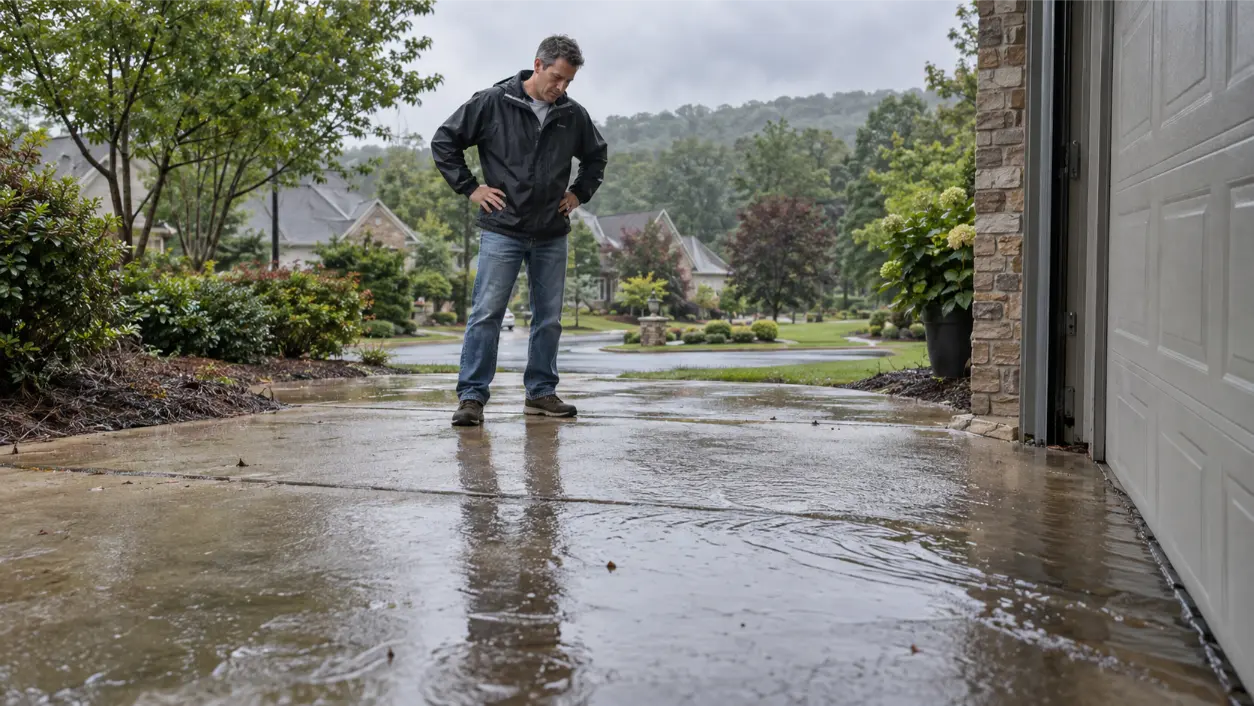
Inspect the area during rain. Look for concentrated flow along the low side, soil channels beside the slab, mulch or gravel washing away, water emerging through a joint, or standing water that remains after the rest of the driveway dries.
Cause 3: The Driveway Edge Lost Lateral Support
A slab edge beside a lawn, slope, ditch, or uncontained shoulder is more vulnerable than an interior section. If soil settles or erodes away from the side, the concrete can lose the confinement that helps support traffic near the edge.
This often appears as a driveway edge dropping beside the lawn while the center remains higher. Tire placement can intensify the problem when vehicles regularly travel close to the unsupported side. A narrow driveway, frequent backing, or a soft shoulder may concentrate loads in the same area every day.
Cause 4: Repeated Heavy Vehicle Loads
Concrete driveways are designed for expected residential use, but repeated loads from delivery trucks, construction equipment, large trailers, recreational vehicles, or commercial vehicles can expose a weak base. The vehicle may not be the original cause; instead, its weight reveals an area that was already poorly supported.
Warning signs include a depressed wheel path, cracking that follows the usual tire line, movement at a joint, or new settlement after a renovation or period of frequent heavy deliveries. The full history of how the driveway has been used can help explain why only one side is changing.
Cause 5: A Utility Trench or Previous Excavation Settled
Water, sewer, drainage, electrical, gas, or communications work may require excavation across or beside a driveway. Even when the surface is restored, trench backfill can settle differently from the undisturbed soil around it.
A long narrow depression, a sinking line that follows a utility route, or settlement near a repaired section may point to this cause. Homeowners should note any past excavation, pipe repair, grading, or construction work when speaking with a contractor.
Cause 6: Roots or Decaying Organic Material Changed the Support
Tree roots can lift, redirect, or disturb soil near concrete. The opposite problem can occur when a large root or buried organic material decays and leaves a void. Removing a tree does not instantly remove every root-related risk because the below-ground material changes gradually.
Look for nearby mature trees, old stumps, recently removed landscaping, or a settlement pattern that radiates from a planting area. Root involvement should be evaluated carefully so the driveway plan does not create a new drainage or tree-health problem.
Cause 7: Moisture-Sensitive Soil Expanded or Shrunk Unevenly
Soil types and moisture conditions vary throughout North Georgia. Some soils change volume more than others as they become wet or dry. If one side of a driveway receives more runoff, shade, irrigation, or drying exposure, the support conditions can become uneven.
Seasonal movement may appear to improve and then return. A slab that changes elevation after long wet or dry periods should be documented over time. The response may involve drainage correction, base stabilization, or a different replacement design depending on the site.
Why Settlement Near the Garage Deserves Early Attention
Concrete driveway settling near a garage can affect the transition between the driveway and garage slab. A low area may collect water at the door, create a vehicle bump, or direct runoff toward the building. Settlement can also place stress on the apron or adjacent walkway.
Check whether the garage slab itself is moving or whether the exterior driveway has dropped away from a stable structure. Water entering the garage, a widening gap, or rapid elevation change deserves prompt evaluation because the consequences extend beyond appearance.
Warning Signs That the Sinking Is Progressing
- The height difference at a joint or crack is increasing.
- One wheel path becomes visibly lower than the other.
- Water begins pooling in a new location or flowing toward the garage.
- Cracks spread outward from the low area.
- The slab rocks, pumps water, or sounds hollow over a broad area.
- Soil, gravel, or mulch is washing away beside the driveway.
- A tire scrapes, a door threshold becomes harder to cross, or the area becomes a trip hazard.
- The low section changed after heavy rain, excavation, or repeated truck traffic.
What a Professional Evaluation Should Consider
An on-site review should look beyond the lowest point. Useful observations include the driveway slope, drainage direction, downspouts, joints, cracks, edge support, nearby retaining conditions, utility history, soil movement, traffic patterns, and the relationship to the garage, road, lawn, and walkways.
Gold City Construction explains that every concrete project begins with understanding existing conditions, drainage, access, layout, and homeowner goals. Homeowners can review the company’s concrete driveway installation and replacement services to understand the scope of its current concrete work.
Can a Sinking Driveway Be Lifted, or Does It Need Replacement?
The answer depends on the cause, slab condition, amount of movement, drainage, and how much of the driveway is affected. Some stable slabs may be candidates for lifting or stabilization by an appropriate concrete-repair specialist. The American Concrete Institute describes slabjacking as a method used to level slabs that have shifted because of settlement, erosion, flooding, or shrinkage of the supporting soil or base.
Replacement may be more practical when the driveway has widespread cracking, deteriorated surfaces, multiple moving sections, poor layout, chronic drainage problems, or insufficient parking. Because Gold City Construction currently markets new driveway installation, replacement, extensions, and flatwork rather than every repair technique, the recommended scope should follow the site evaluation rather than a predetermined repair method.
Homeowners comparing finished exterior work can browse Gold City Construction’s project gallery for examples of concrete and other exterior projects.
What Homeowners Can Do Before the Estimate
- Photograph the low area from the same locations over several weeks.
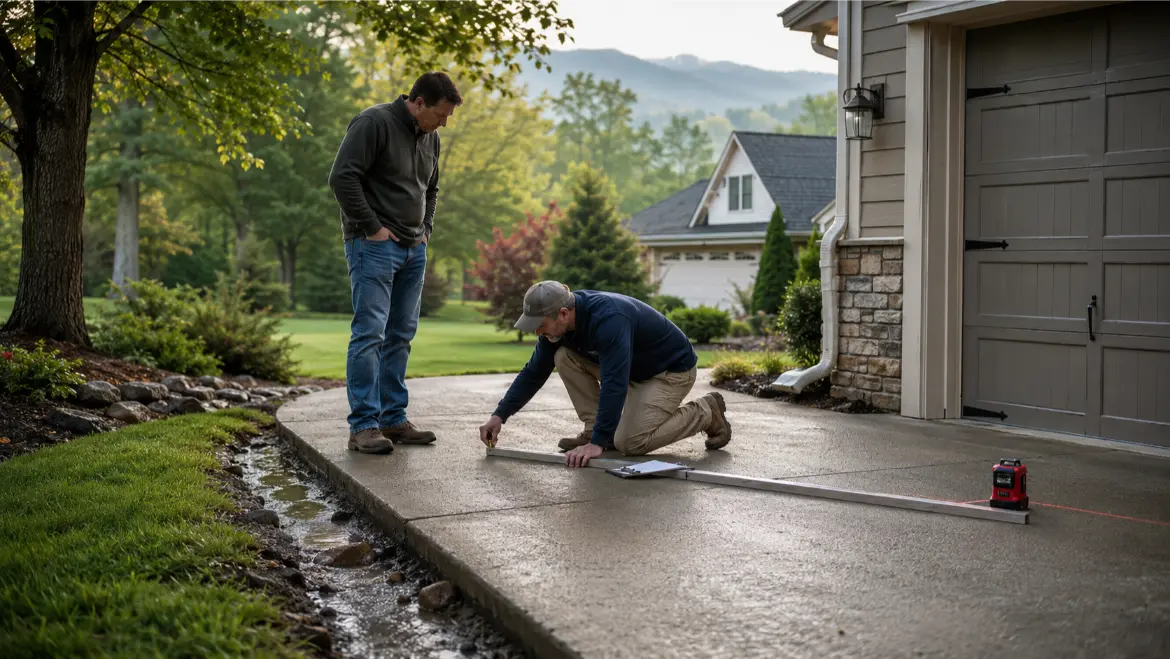
- Measure the elevation difference with a straightedge and ruler.
- Mark where water flows during a normal rain and during a heavy storm.
- Redirect temporary downspout discharge away from the affected area when it can be done safely.
- Avoid parking unusually heavy vehicles on the sinking edge.
- Write down past utility work, grading, tree removal, or driveway extensions.
- Do not fill a suspected void with random soil, gravel, or expanding material without understanding where it will go.
These steps do not replace an inspection, but they create a clearer record of how the area behaves and whether the movement is continuing.
How Gold City Construction Helps North Georgia Homeowners
Gold City Construction provides residential concrete driveway installation, replacement, extensions, and flatwork for homeowners across North Georgia and North Atlanta communities. Its estimate process includes an on-site visit to evaluate existing conditions, measurements, drainage, access needs, and the homeowner’s goals.
When a sinking section affects parking, safety, drainage, or access, homeowners can request a free on-site estimate to discuss whether replacement, an extension, or a redesigned concrete layout may be appropriate. An estimate is not a guarantee that full replacement is required; the purpose is to understand the property and practical project options.
Frequently Asked Questions
Why is only one side of my driveway sinking?
One side may have weaker compaction, more water exposure, less edge support, a buried utility trench, root activity, or heavier wheel loading. The visible location usually reflects where the support became less uniform.
Can poor drainage cause a concrete driveway to settle?
Yes. Concentrated runoff can erode soil beside or beneath the slab, soften supporting material, and contribute to voids or uneven settlement. Correcting the water path is often an important part of the solution.
Is a sinking driveway dangerous?
It can become a safety concern when it creates a trip edge, unstable slab, vehicle clearance problem, or drainage path toward a building. Rapid movement, rocking, or water pumping deserves prompt attention.
Will sealing the cracks stop the driveway from sinking?
Sealing may help limit water entry in some cracks, but it does not restore lost support or correct erosion, settlement, or poor compaction beneath the slab.
Can heavy trucks make one wheel path sink?
Repeated heavy loads can accelerate settlement where the base or edge support is already weak. The load may reveal an underlying problem rather than being the only cause.
Does an uneven driveway always need to be replaced?
No. The appropriate response depends on the cause, slab condition, movement, drainage, affected area, and available repair methods. An on-site evaluation helps determine whether monitoring, specialized lifting, drainage work, partial reconstruction, or replacement is the practical path.
This article provides general homeowner education and is not an engineering assessment. Sudden movement, suspected structural impact, severe erosion, or conditions affecting a building may require review by a qualified engineer or other appropriate professional.
RELATED LINK: American Concrete Institute – RAP-11: Slabjacking