Steep driveway safety becomes a real concern when the slope, surface, drainage, and connection to the street or garage no longer work together.
A driveway may appear usable in dry weather but become difficult during a North Georgia rainstorm, when vehicles lose traction, runoff crosses the driving path, tires spin near the garage, or a bumper scrapes at a sharp transition.
There is no single slope percentage that automatically makes every residential driveway unsafe. Vehicle type, driveway length, surface texture, drainage, curves, visibility, garage elevation, pedestrian routes, and maintenance condition all affect performance. The right question is whether the driveway provides predictable access during the conditions the household actually experiences.
Why Steep Driveways Demand More From the Surface
On a level driveway, tires mainly need enough friction to start, stop, and turn. On a grade, gravity adds another force. A vehicle climbing the slope needs traction to keep moving without wheel spin. A vehicle descending needs enough friction and braking distance to slow before reaching the street, garage, gate, or parked vehicle.
Wet weather increases the demand. Federal Highway Administration guidance notes that water on pavement can significantly reduce tire-pavement friction and that drainage problems, grades, and ponding can contribute to wet-weather safety problems. For a residential driveway, that means the slope cannot be evaluated independently from where water flows and how quickly it leaves the driving surface.
Warning Sign 1: Tires Slip or Spin During Rain
Occasional wheel spin may relate to worn tires, heavy acceleration, leaves, mud, algae, or an unusually strong storm. Repeated slipping in the same area is more significant. It can indicate that the surface has become polished, the finish is too smooth for the grade, water is crossing the tire path, or sediment and organic growth are reducing traction.
Notice where the slipping occurs. Problems near the street may involve the apron or an abrupt grade change. Problems near the garage may involve water discharge, a smooth finished area, or the final approach angle. Problems in a curve can reflect both slope and turning demand.
Warning Sign 2: Vehicles Scrape at the Street or Garage
A driveway can have a manageable overall grade and still create trouble at its transitions. The underside, front bumper, hitch, running boards, or exhaust may scrape where the driveway rises too sharply from the road or changes angle near the garage slab.
These points should be evaluated as vertical transitions, not simply as a steep driveway. Lengthening the transition, adjusting the profile, or rebuilding a localized section may improve clearance. The correct approach depends on the available space, road connection, drainage path, garage elevation, and the vehicles regularly using the property.
Warning Sign 3: Water Runs Down the Tire Path
Water following the same path as the vehicles can reduce traction and accelerate surface and edge problems. Fast runoff may carry soil, mulch, gravel, or leaves onto the concrete. It may also concentrate at joints, low areas, the garage entrance, or the bottom of the driveway.
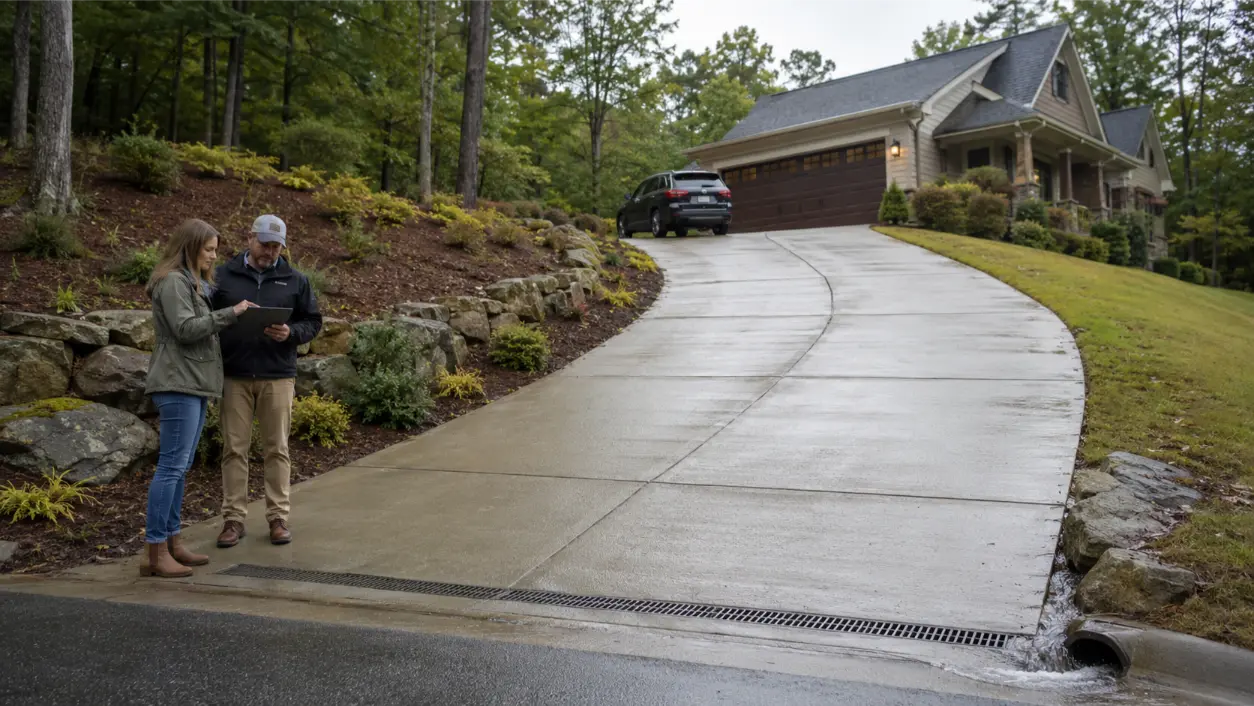
Drainage planning should identify where water comes from and where it can safely go. Relevant sources may include the upper yard, roof downspouts, roadside runoff, neighboring grades, retaining-wall areas, and the driveway itself. A surface treatment alone is unlikely to solve a problem caused by concentrated water moving across the driveway.
Warning Sign 4: Water Ponds or Freezes in Isolated Areas
Standing water suggests that the surface is not draining consistently. Low spots can form from settlement, poor grading, localized failure, or a transition that traps water. Ponding is inconvenient in warm weather and more serious when temperatures fall below freezing.
North Georgia does not experience constant winter ice, but shaded and elevated properties can still develop slick patches. A steep driveway with one recurring wet or icy area can become difficult even when the rest of the surface performs well.
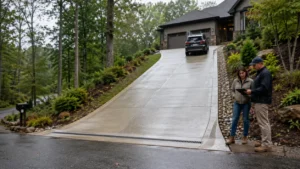
Warning Sign 5: Walking the Driveway Feels Unstable
A driveway is often also a pedestrian route to the mailbox, trash containers, vehicles, side yard, or street. Watch for areas where people avoid the concrete, walk on the grass, hold onto vehicles, or take very short steps during rain.
Pedestrian concerns can involve slope, cross-slope, algae, loose debris, cracks, uneven panels, poor lighting, or a lack of a practical walking path. Improving vehicle traction does not automatically make the route comfortable for children, older adults, delivery drivers, or visitors.
Warning Sign 6: Cracks, Settlement, or Edge Failure Change the Driving Line
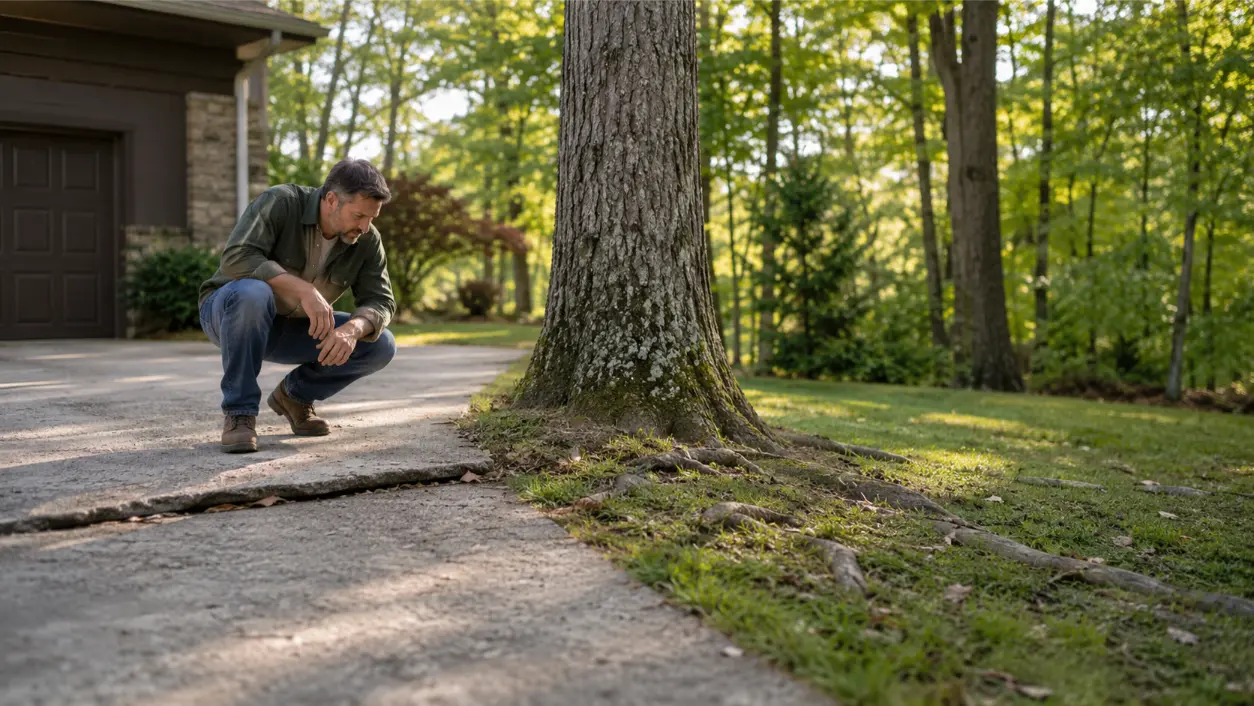
Cracks are not always a safety emergency, but movement can change how a steep driveway drains and how tires contact the surface. A settled panel may create a lip, collect water, or force drivers toward a weak edge. Eroded shoulders can remove lateral support and make the usable width feel narrower.
Pay attention when deterioration changes the path vehicles use. Drivers may begin approaching the garage at an angle, hugging one side to avoid a low spot, or accelerating more aggressively to clear a rough section. Those adaptations indicate that the driveway is no longer providing predictable access.
Warning Sign 7: The Surface Has Become Smooth or Polished
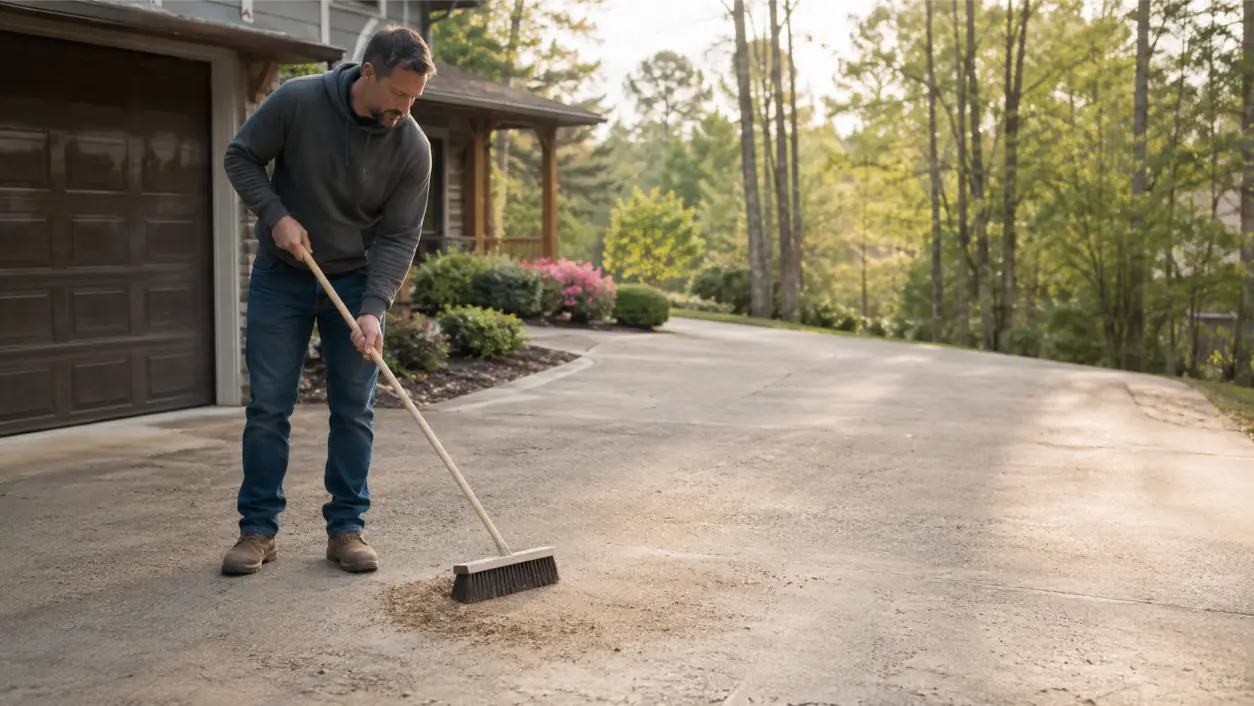
Concrete texture contributes to skid resistance. The American Concrete Institute explains that traveled surfaces need texture for friction and that both fine surface texture and deeper grooves affect pavement performance. A broomed or otherwise appropriately textured exterior finish can help water escape from beneath tires and provide a more secure contact surface.
Texture must still be matched to the project. A very aggressive finish can be uncomfortable for walking, difficult to clean, or visually inconsistent. A contractor should consider the driveway grade, expected traffic, drainage, and surrounding flatwork before recommending a finish or rehabilitation method.
How Slope, Drainage, and Texture Work Together
Homeowners sometimes focus on one symptom: “The concrete is slippery,” “The water runs too fast,” or “The driveway is too steep.” In practice, these conditions interact.
- Slope determines how strongly gravity affects vehicles and runoff.
- Drainage determines whether water leaves the surface or remains in the tire and walking paths.
- Texture helps provide friction, especially when the surface is wet.
- Profile transitions determine vehicle clearance at the street, garage, and grade changes.
- Width and alignment affect turning, passing, backing, and edge loading.
- Base and edge support help the slab remain stable under repeated vehicle loads and water exposure.
A safe design balances these factors. Adding texture without correcting ponding may leave the main hazard in place. Redirecting water without checking where it discharges may create erosion elsewhere. Replacing concrete without planning the approach angles can reproduce the same scraping problem.
What a Professional Site Review Should Examine
A useful driveway evaluation begins with the whole property rather than only the damaged area. The contractor should review:
- The driveway’s approximate grade, length, curves, and narrow points.
- The street connection, culvert, shoulder, apron, and sight distance.
- The transition into the garage, parking pad, turnaround, or carport.
- Roof, yard, roadside, and uphill runoff sources.
- Standing water, erosion, sediment trails, and stained flow paths.
- Concrete texture, polishing, cracking, settlement, and joint condition.
- Vehicle types, including low-clearance cars, trucks, trailers, and service vehicles.
- Pedestrian routes, lighting, steps, handrails, and adjacent walkways.
- Space available for a longer transition, drainage feature, parking area, or turnaround.
Gold City Construction describes this property-first approach on its concrete driveway service page, where existing conditions, drainage, access needs, layout, and homeowner goals are reviewed before a scope is recommended.
Possible Improvement Strategies
The right solution depends on why the driveway is difficult. A site may need one targeted correction or a coordinated redesign.
Improve surface texture
For new concrete, the finish can be selected to provide appropriate exterior traction. An existing surface may be evaluated for cleaning, mechanical texturing, overlays, or replacement, depending on its condition and the compatibility of the proposed treatment.
Correct drainage and runoff paths
Drainage improvements may involve regrading, swales, trench or channel drains, catch basins, downspout routing, culvert work, or changes to adjacent landscaping. The discharge point must be considered so water is not simply moved toward the house, a neighbor, an unstable slope, or the public roadway.
Rebuild problem transitions
Localized reconstruction may help where vehicles scrape at the road or garage. The goal is a smoother vertical profile that maintains drainage and does not create a new low point.
Add a parking pad or turnaround
Backing down a long or curved hill can be uncomfortable and may limit visibility. Where property conditions allow, a parking pad or turnaround can reduce repeated backing movements and create a more useful staging area near the home.
Separate the pedestrian route
A connected walkway, steps, landing, or handrail may provide safer access than asking every pedestrian to use the steepest vehicle path. The route should be planned with lighting, drainage, and household needs in mind.
Replace unstable or poorly configured sections
Replacement may be appropriate when cracking, settlement, drainage failure, weak edges, or an unsuitable layout affect large portions of the driveway. Gold City Construction’s completed project gallery provides examples of concrete and exterior improvements homeowners can review before planning an estimate.
When the Driveway Should Be Reviewed Promptly
Schedule an evaluation sooner when vehicles repeatedly slide toward the street or garage, water enters the garage, a slab has a growing vertical offset, runoff erodes the driveway edge, a culvert or drain is blocked, or pedestrians cannot use the route confidently. Avoid driving over visibly undermined edges or severely displaced concrete until the condition has been assessed.
Immediate conditions such as an active washout, exposed utility, collapsed drainage structure, or a surface that cannot be used without losing control may require restricting access and contacting the appropriate emergency, utility, road, or property professional.
A Homeowner Checklist for Wet-Weather Observation
- Observe the driveway from a safe location during moderate rain.
- Record where water enters, crosses, ponds, and exits the surface.
- Note where tires spin, slide, or require extra acceleration.
- Check for scraping at the road, garage, and grade transitions.
- Photograph sediment trails, erosion, cracks, offsets, and low spots.
- Identify downspouts or yard drainage directed toward the driveway.
- List every vehicle that must use the driveway regularly.
- Walk the route after rain and note slippery or uncomfortable areas.
- Discuss parking, turnaround, delivery, trailer, and emergency-access needs.
- Share the observations during the on-site estimate.
How Gold City Construction Helps North Georgia Homeowners
Gold City Construction installs and replaces concrete driveways, driveway extensions, walkways, pads, and related residential flatwork for homeowners throughout North Georgia and North Atlanta. The company’s process begins with an on-site review of the property, existing conditions, drainage, access, layout, and household goals.
Homeowners dealing with a slippery hill, scraping vehicles, standing water, or an aging driveway can request a free concrete driveway estimate to discuss practical options. Recommendations and final scope depend on the property, drainage, soil and base conditions, local requirements, vehicle needs, and the condition of the existing concrete.
Frequently Asked Questions
What driveway slope is considered too steep?
There is no single residential percentage that determines safety for every property. Overall grade, length, transitions, curves, surface texture, drainage, visibility, vehicle clearance, and local requirements all matter. A site-specific review is more useful than relying on one number.
Why is my concrete driveway slippery only when it rains?
Water reduces tire-pavement friction. A smooth or polished surface, algae, sediment, leaves, poor drainage, and concentrated runoff can make the condition worse. The cause should be identified before selecting a surface treatment.
Can a steep driveway be made less slippery without replacement?
Sometimes. Cleaning, drainage correction, mechanical texturing, or a compatible surface treatment may help when the slab is stable. Replacement may be more appropriate when the profile, settlement, cracking, or drainage design is the main problem.
How can I stop a vehicle from scraping at the garage entrance?
The transition profile must be evaluated. A localized rebuild or longer grade transition may improve clearance, but the solution must preserve drainage and match the road, driveway, and garage elevations.
Would a drain across the driveway solve runoff?
A channel or trench drain may be part of the solution, but it must be sized, located, maintained, and connected to an appropriate discharge path. The upstream water source and downstream erosion risk should also be reviewed.
Should pedestrians use a separate route on a steep property?
A separate walkway, steps, landing, or handrail may provide safer and more comfortable access, especially when the vehicle path is steep, curved, wet, or poorly lit. The best layout depends on the property and household.
This article provides general residential construction information. Driveway design, drainage, safety, permitting, and repair decisions are site-specific and may require evaluation by qualified contractors, engineers, local authorities, or other professionals.
RELATED LINK: American Concrete Institute — Purpose of Finishing and Texturing Concrete Surfaces