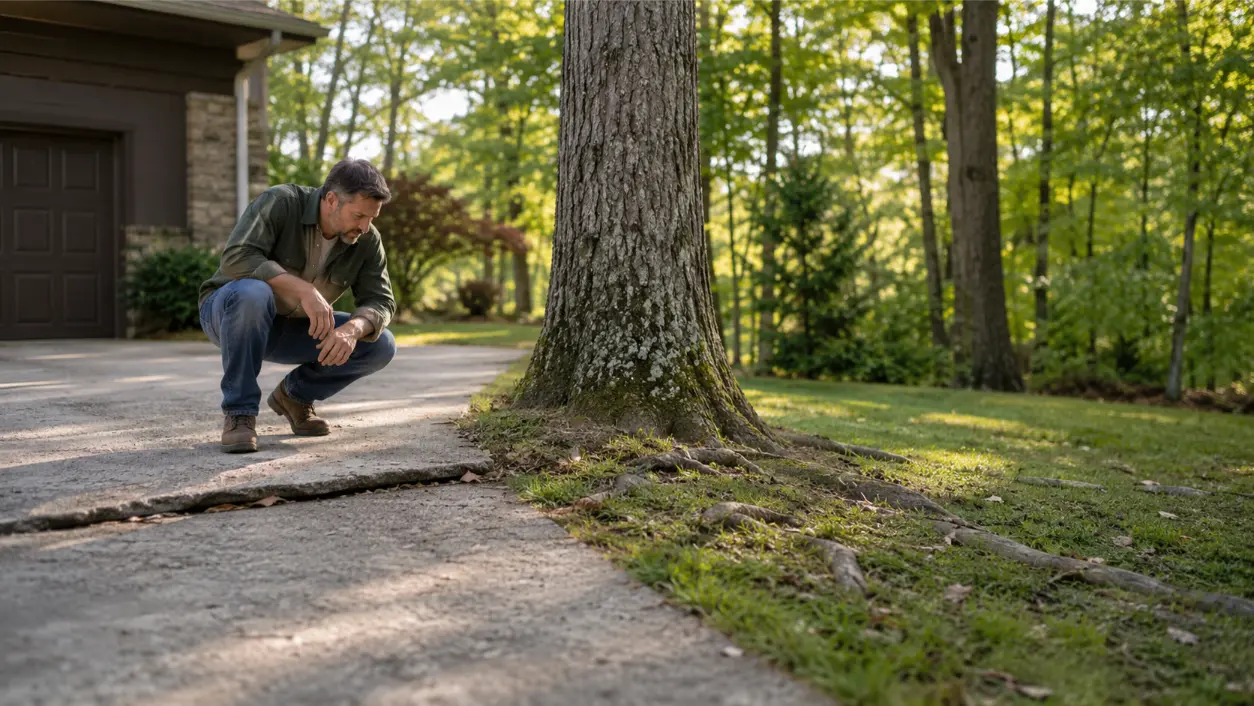
If you suspect tree roots under driveway concrete because slabs are lifting or cracking near a mature tree, the roots may be part of the problem—but they are not the only possible cause.
Concrete can also move because of settlement, erosion, poor base preparation, drainage changes, expansive soils, or combinations of those conditions. The useful clue is the pattern: a slab edge that rises closest to a large tree, cracks that develop near the root zone, or repeated movement in the same tree-side area can justify a closer look at both the pavement and the tree.
Gold City Construction provides concrete driveway installation, replacement, extensions, and residential flatwork for homeowners across North Georgia. Its current concrete process considers existing conditions, drainage, access, layout, and homeowner goals before recommending a scope. When mature trees are close to the driveway, that site review matters because a replacement should address more than the broken concrete; it should also account for the conditions that may affect the next slab.
Can Tree Roots Really Grow Under a Concrete Driveway?
Yes. Most of a mature tree’s active root system is relatively shallow and extends horizontally away from the trunk. University of Georgia Extension notes that active root growth commonly occurs within the upper 18 inches of soil, and other UGA guidance explains that most roots in Georgia clay soils are concentrated in the upper 12 to 18 inches. That puts roots in the same general zone occupied by driveway base material and the soil immediately beneath pavement.
Roots do not have to push directly through sound concrete to create a conflict. They can grow into favorable soil beside or beneath the slab. As woody roots increase in diameter over time, they may change the support conditions under an edge or joint. If the slab does not have room to accommodate that change, lifting, cracking, or separation can occur.
Why Mature Trees and Driveways Often Compete for the Same Space
Driveways require compacted, load-bearing support. Tree roots require oxygen, water, and usable soil volume. Those needs can conflict on wooded residential lots where a driveway passes close to established trees.
UGA Extension explains that compaction reduces soil pore space that normally holds air and moisture. Roots may remain closer to the surface where conditions are more favorable. Construction traffic, parking, grading, and repeated vehicle movement can increase compaction around trees. At the same time, roots already growing in the area continue to thicken as the tree matures.
This is why a driveway that looked fine for years can begin developing a raised panel later. The tree may have grown substantially since the pavement was placed, or soil and drainage conditions around the roots may have changed.
Signs That Roots May Be Contributing to Uneven Concrete
No single surface crack proves that roots are underneath it. Look for a group of clues instead.
- A slab or corner is lifting upward rather than simply sinking.
- The highest point of the movement is closest to a mature tree.
- Surface roots are visible in the lawn or landscape between the trunk and driveway.
- Cracks or joint offsets develop along the tree-facing edge of the pavement.
- A previously level driveway becomes progressively uneven as the tree grows.
- The same area has been repaired before and movement has returned.
- The driveway is otherwise well supported, while one tree-side section shows localized uplift.
These clues can support a root-related hypothesis, but an on-site evaluation is still important. A lifted slab can coexist with settlement on the opposite side, drainage erosion, or weak base material.
Roots Can Lift Pavement Without Being the Only Cause of Cracking
Tree-root conflicts are often discussed as if the root simply “breaks” concrete. In practice, the process can be more complicated. The root enlarges in the soil, support under the slab changes, and the rigid concrete responds to differential movement. The slab may rotate, lift at a joint, or crack where stresses concentrate.
Research published through the International Society of Arboriculture has documented the well-known conflict between woody roots and hardscape, including roots that crack or lift sidewalks. Similar mechanisms can affect residential driveways, especially where trees have limited rooting space or pavement is close to the trunk.
Do Not Cut a Large Root Just to Make the Slab Flat
One of the highest-risk homeowner responses is to expose a large root and cut it without understanding its role in the tree. UGA Extension warns that major lateral roots help stabilize trees and that cutting structural roots can cause permanent injury or reduce stability. Tree decline may not appear immediately after root damage.
The International Society of Arboriculture also recommends professional evaluation when trenching, grading, paving, or excavation may damage roots. A qualified arborist can help assess whether a root can be pruned, whether the tree’s stability would be affected, and whether a layout change would be safer.
For that reason, driveway demolition and tree-root decisions should be coordinated rather than treated as two separate jobs when a mature tree is close to the work area.
Why Driveway Replacement Can Also Damage the Tree
Removing an old slab and preparing for new concrete involves more than pouring. Demolition, excavation, base preparation, grading, and equipment traffic can disturb the root zone. UGA and ISA resources identify severed roots, soil compaction, grade changes, drainage changes, and added fill as construction-related stresses that can harm trees.
The visible driveway may occupy only a narrow strip, but roots can extend well beyond the tree canopy and into nearby work areas. Damage to important roots can affect water uptake, stability, and long-term tree health. Symptoms may take years to become obvious.
If preserving the tree is a priority, identify that goal before demolition begins rather than after roots have already been exposed or cut.
Replacement Layout Options May Reduce Future Conflict
A replacement does not always have to reproduce the exact old footprint. Depending on property access, drainage, zoning, tree location, and homeowner goals, the project team may be able to evaluate alternative geometry.
- Shift or curve part of the driveway farther from the trunk where space allows.
- Reduce pavement width near a tree while maintaining practical vehicle access.
- Move a joint or slab edge so it does not repeat the same conflict point.
- Change an extension or parking layout to use a less root-sensitive area.
- Coordinate excavation limits with an arborist when important roots are expected.
- Evaluate whether root-management or root-barrier strategies are appropriate for new work without compromising tree stability.
UGA Cooperative Extension describes root barriers as one tool used around paving, including driveways, but installation requires trenching and can sever existing roots. That means a barrier is not a simple retrofit to place beside every mature tree. Its suitability depends on tree species, root location, soil, distance from the trunk, and the planned pavement.
Sometimes the Better Choice Is to Change the Driveway, Not the Tree
If a healthy mature tree is important to the property, relocating a section of pavement can sometimes be preferable to aggressive root cutting. The opposite can also be true: a hazardous, declining, poorly located, or structurally compromised tree may require an arborist’s recommendation before major concrete work proceeds.
There is no universal answer because the value and condition of the tree, driveway access needs, replacement cost, drainage, site geometry, and safety all matter. The practical goal is to avoid spending money on a new slab while leaving the same unresolved conflict beneath or beside it.
How to Separate Root Uplift From Settlement
Homeowners often describe any uneven concrete as “sinking,” but root-related movement can look different from settlement.
- Likely uplift pattern: one edge rises, often nearest a tree or visible root line.
- Likely settlement pattern: a panel drops below surrounding concrete, often near poorly compacted fill, erosion, or drainage problems.
- Mixed pattern: one side is lifted while another loses support, making the panel tilt.
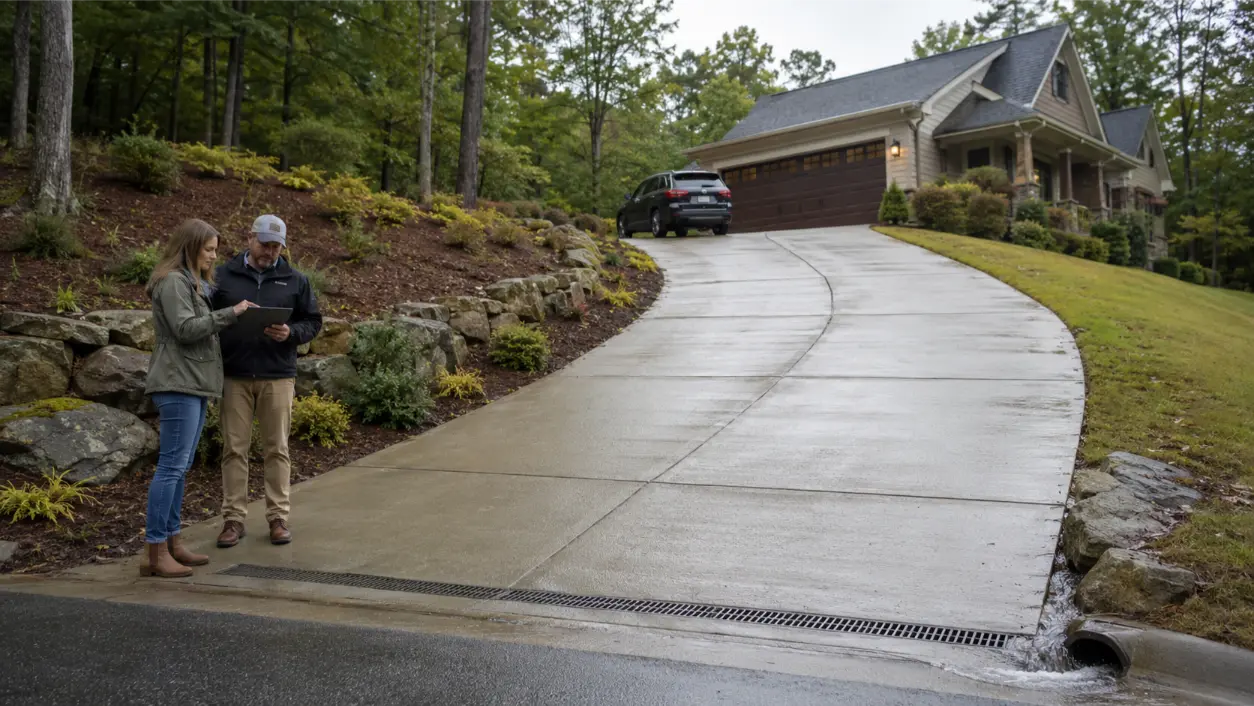
Drainage can complicate the picture. Water moving along a driveway edge can erode support while roots are simultaneously changing the soil profile. That is why Gold City Construction’s current concrete process includes review of existing conditions and drainage as part of project planning.
What to Document Before Requesting an Estimate
- Photograph the tree, driveway, and the entire affected area from several angles.
- Note whether the concrete is lifted, sunk, cracked, or all three.
- Look for visible surface roots between the tree and driveway.
- Measure the vertical offset at raised joints if it can be done safely.
- Watch the area during rain for runoff, ponding, or erosion.
- Note how long the movement has been visible and whether it is getting worse.
- Identify which trees you want to preserve before discussing replacement options.
- Contact an arborist before cutting any large or structural roots.
This information helps a concrete contractor understand the pavement problem and helps an arborist understand the construction goals.
Questions to Ask Before Replacing a Driveway Near Trees
- Does the movement look like uplift, settlement, or a combination?
- Will demolition expose roots that need arborist evaluation?
- Can the replacement footprint move farther from the tree?
- How will equipment access avoid unnecessary root-zone compaction?
- Does drainage need to change with the new driveway?
- Would a different joint layout reduce stress near the tree?
- Are root barriers or other root-management measures appropriate here?
- What site conditions could cause the new concrete to move again?
Frequently Asked Questions
Can roots grow under a concrete slab?
Yes. Tree roots commonly grow in shallow soil and can extend beneath or alongside paved areas. As roots enlarge, they can change support conditions under the concrete and contribute to lifting or cracking.
How do I know whether tree roots are lifting my driveway?
Look for localized uplift nearest a mature tree, visible surface roots between the tree and pavement, and movement that progresses as the tree grows. Those signs are suggestive, not conclusive; settlement and drainage problems should also be considered.
Can I cut the root and replace the concrete?
Do not cut a major root without professional guidance. UGA Extension warns that structural root loss can permanently damage or destabilize a tree. A qualified arborist can evaluate root importance and tree risk before excavation or root pruning.
Can a driveway be replaced without damaging a mature tree?
Sometimes, but no contractor can guarantee zero root impact without understanding the site. Planning can reduce risk by limiting excavation, controlling equipment access, adjusting the layout, protecting root-zone soil, and coordinating with an arborist when significant roots are involved.
Will a root barrier stop the problem permanently?
Root barriers can redirect or limit root growth in some situations, but they are site-specific and may require trenching through existing roots. They should be evaluated carefully around mature trees rather than treated as a universal solution.
Plan for the Tree and the Driveway Together
A raised slab beside a mature tree is not just a concrete problem or just a tree problem. The safest long-term plan considers the pavement, root system, soil support, drainage, access needs, and the homeowner’s priorities together. Replacing damaged concrete without understanding why it moved can leave the same conflict waiting beneath the new work.
Gold City Construction provides concrete driveway installation, replacement, extensions, and flatwork for homeowners in Dahlonega, Dawsonville, Gainesville, Cumming, Alpharetta, Milton, Canton, Woodstock, Roswell, North Atlanta, and nearby North Georgia communities. If tree-side slabs are lifting or cracking, you can review the company’s concrete driveway services or request a free estimate to discuss the pavement, drainage, and possible replacement layout. Where significant root disturbance may be required, an arborist should be part of the planning conversation.
Construction, tree-health, and safety disclaimer: This article provides general educational information and is not a substitute for an on-site evaluation by a qualified concrete contractor, certified arborist, engineer, or other appropriate professional. Root location, tree stability, soil conditions, drainage, excavation limits, permits, and replacement design vary by property. Do not sever large or structural roots based solely on surface appearance.
RELATED LINK: University of Georgia Extension — Troublesome Tree Roots