

The most useful driveway crack warning signs are not based on appearance alone.
A narrow line may remain stable for years, while a crack that widens, shifts vertically, collects water, or spreads into a larger pattern may point to movement below the concrete. For North Georgia homeowners, the practical question is not simply whether a driveway has a crack, but whether that crack is changing and affecting the slab around it.
Concrete naturally expands, contracts, and responds to changes in moisture, temperature, load, and support conditions. Some early hairline cracks are mainly cosmetic. Others become pathways for water or evidence that the base, drainage, or soil beneath the driveway is no longer supporting the slab evenly. A simple monitoring routine can help you distinguish a stable imperfection from a condition that deserves a closer look.
A Small Crack Is Not Automatically an Emergency
Concrete is not completely crack-proof. Shrinkage during curing, changes in temperature, minor settlement, and movement around joints can all create visible lines. A single tight crack with no vertical movement, no crumbling edges, and no measurable change may only need observation.
The concern increases when the crack behaves like an active joint: it opens and closes noticeably, one side rises or sinks, nearby edges chip away, or new branches develop. The pattern and progression often reveal more than the original width.
Start by Recording the Crack Instead of Guessing
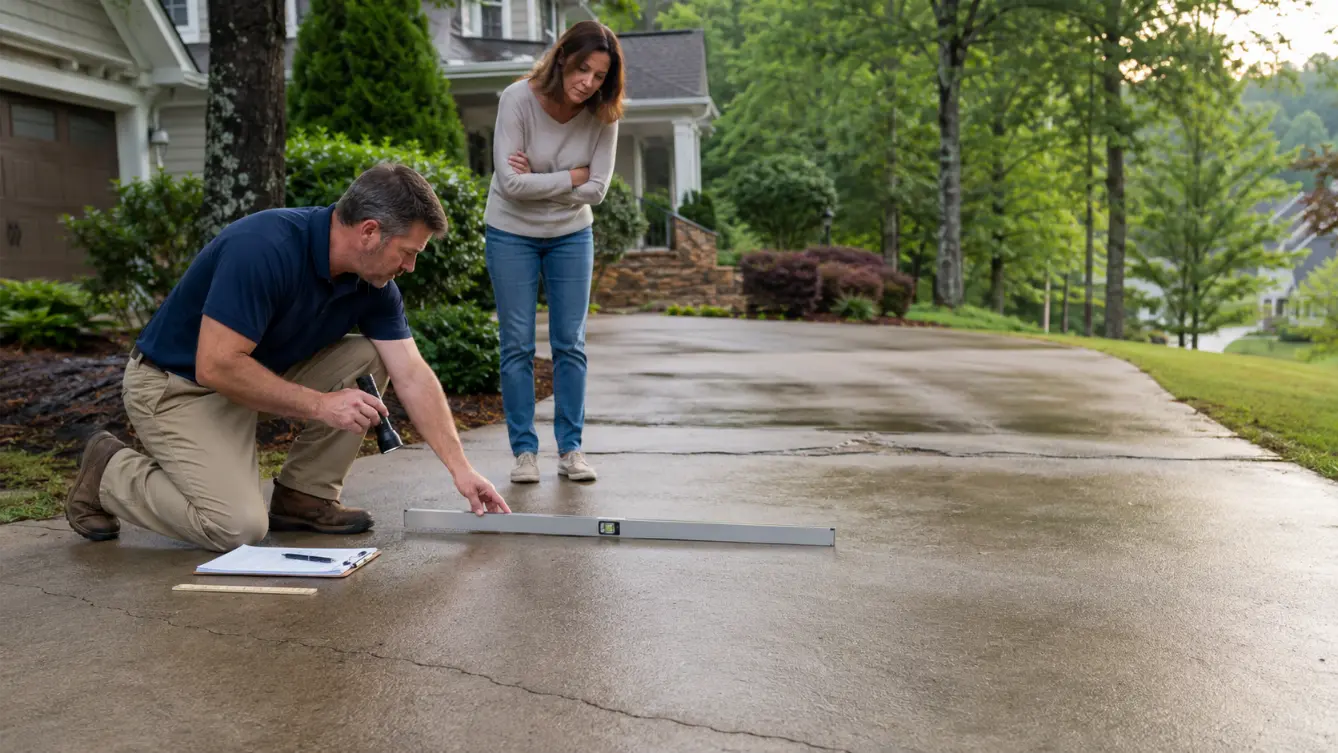
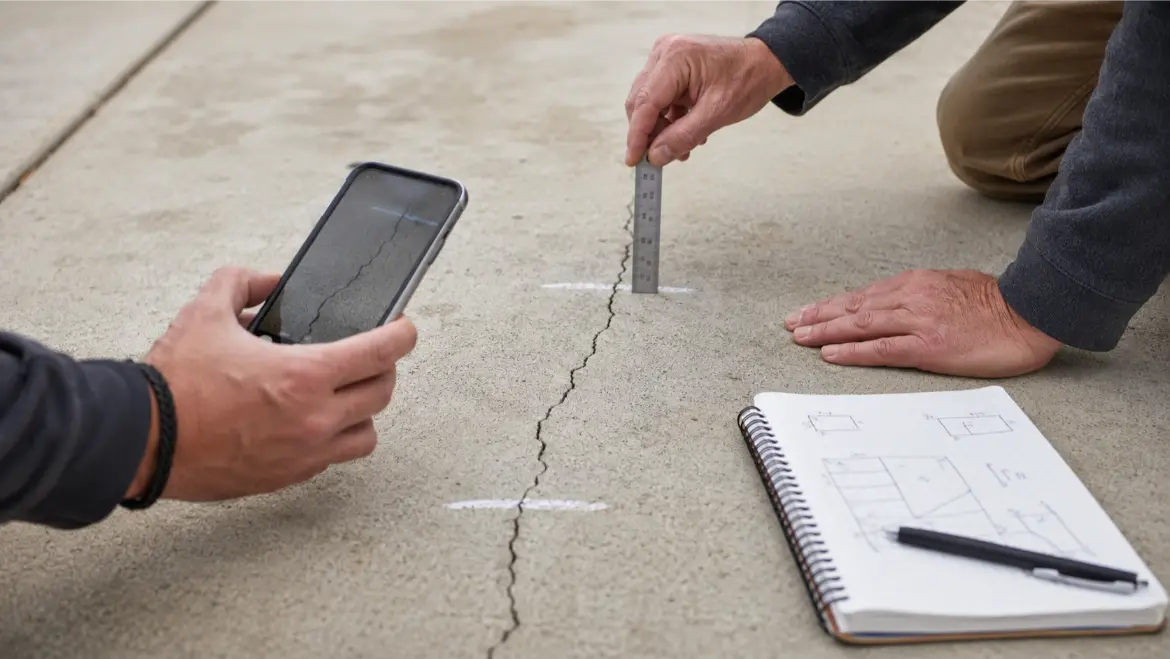
Take clear photographs from the same angle and include a ruler or another consistent scale. Note the date, weather conditions, approximate width, length, and location. Mark the ends lightly with chalk so you can see whether the crack extends. Repeat the check after a heavy rain, a long dry period, or a significant temperature change.
This simple record is useful because memory is unreliable. A homeowner may feel that a crack “suddenly got worse” when it has changed slowly for months, or may worry about a line that has actually remained stable. Documentation gives a contractor more useful information during an evaluation.
Warning Sign 1: The Crack Is Getting Wider or Longer
Progression is one of the clearest reasons to pay attention. A crack that steadily widens, extends across a slab, or develops new branches suggests that the concrete is still moving or losing support. The rate of change matters more than a single measurement taken once.
Do not rely on one universal width threshold. Residential driveways vary in slab thickness, reinforcement, joint layout, soil conditions, drainage, age, and traffic. A relatively narrow crack can still be significant if it is moving vertically, while a wider but stable joint-like crack may have a different cause. Use width as one part of the assessment, not the entire diagnosis.
Warning Sign 2: One Side of the Crack Is Higher Than the Other
Vertical displacement, sometimes called faulting, deserves prompt attention because it can indicate uneven support beneath the slab. It also creates a trip hazard and can affect vehicle movement, drainage, and everyday access.
Look across the driveway at a low angle or place a straightedge over the crack. If one side has dropped, tilted, or lifted, the issue is no longer only a surface line. The slab may be responding to settlement, erosion, expansive soil, roots, frost-related movement, or a void below the concrete.
Warning Sign 3: Water Is Entering or Collecting Around the Crack
Water can turn a minor surface defect into a larger maintenance problem. It may carry fine soil away from beneath the slab, soften poorly drained areas, freeze during cold periods, or contribute to repeated movement as the ground becomes wet and dry.
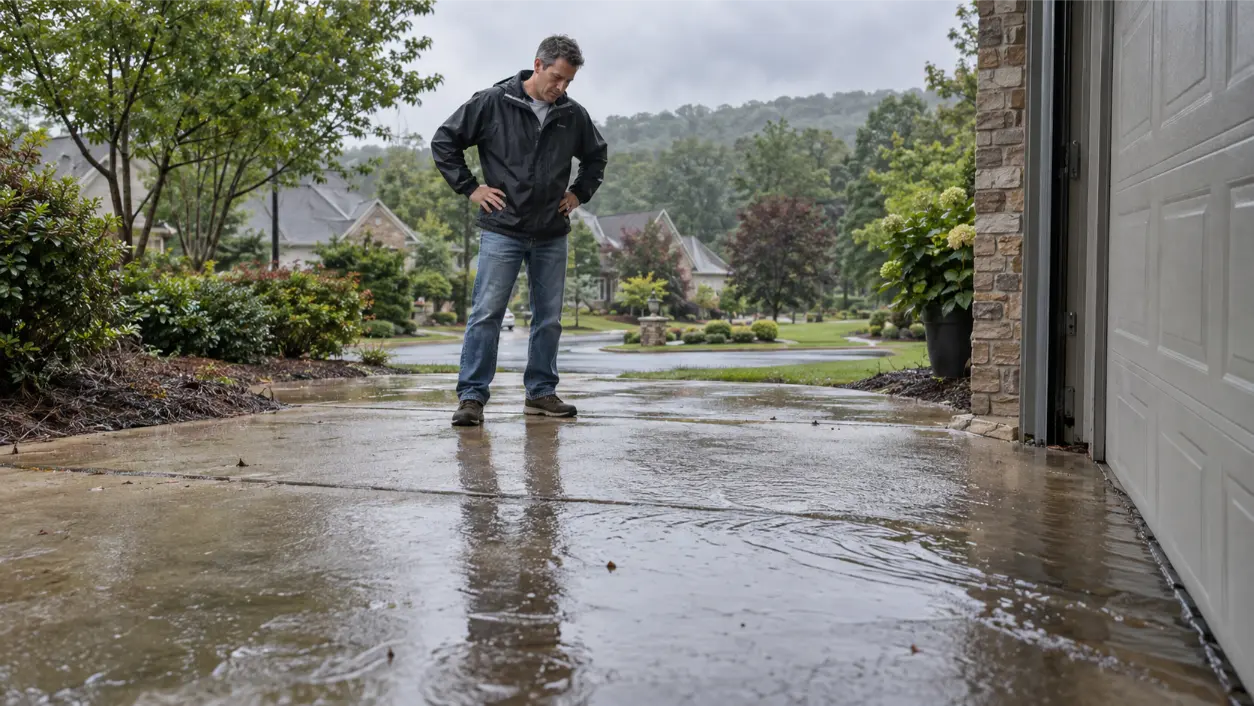
Inspect the driveway during and after rain. Watch for water flowing into the crack, pooling beside a sunken section, emerging from the crack under vehicle load, or moving toward the garage or foundation. Drainage problems should be evaluated as part of the driveway condition rather than treated as a separate cosmetic issue.
Warning Sign 4: The Crack Forms a Pattern
A single straight crack can have a different meaning from several intersecting cracks. Branching, map-like cracking, corner breaks, or a slab divided into multiple moving pieces may signal broader deterioration or uneven support.
Pay close attention to cracks that repeat near control joints, follow the edges of the driveway, surround a visibly depressed area, or form across several neighboring slabs. A pattern can show that the problem is not isolated to one small spot.
Warning Sign 5: The Edges Are Spalling or Crumbling
Spalling occurs when pieces of the concrete surface or crack edge break away. Once the edges begin to deteriorate, tires, water, debris, and repeated movement can accelerate the damage. The crack may become wider even if the underlying movement has slowed.
Other surface clues include scaling, flaking, exposed aggregate, rust-colored staining, or loose fragments. These signs do not identify the cause by themselves, but they show that the concrete around the crack is losing material and should not be ignored.
Warning Sign 6: The Driveway Feels Hollow, Rocks, or Pumps Water
A slab that moves under a vehicle, produces a hollow sound over a broad area, or pushes water and fine material through a crack may have a void or weakened support beneath it. These conditions can allow repeated flexing, which increases stress and may create additional cracks.
Do not attempt to diagnose a void by repeatedly driving over a questionable section or striking the slab aggressively. Note the location and request an on-site evaluation, especially when movement is visible or the affected area is used daily.
Warning Sign 7: The Crack Appeared After Winter and Keeps Changing
Homeowners often notice new driveway cracks after winter because colder temperatures, moisture, and repeated weather changes make existing movement easier to see. North Georgia does not experience the same winter conditions every year, but cold snaps, rain, and occasional freeze-thaw cycles can expose weak drainage, saturated base material, or existing surface deterioration.
A new hairline crack after winter may remain stable. The more important question is what happens during spring rain and summer drying. Continue monitoring the crack for widening, settlement, spalling, or water movement rather than deciding based on the season alone.
Warning Sign 8: The Crack Is Near a Garage, Foundation, Drain, or Retaining Edge
Location changes the risk. A crack near the garage apron can affect the transition into the building. A crack beside a drain or low area may collect water. Damage near a retaining edge, culvert, steep slope, or unsupported driveway border may indicate erosion or loss of confinement.
These areas deserve earlier review because movement can affect adjacent structures, access, or drainage. A contractor should evaluate the whole property condition rather than focusing only on the visible line.
When to Request a Professional Driveway Inspection
Schedule an evaluation when you see vertical displacement, rapid widening, multiple intersecting cracks, sinking sections, water pumping, significant edge breakdown, repeated pooling, or a new trip hazard. Sudden movement after excavation, utility work, heavy equipment, flooding, or a drainage change also deserves attention.
A professional assessment should consider the slab, joints, slope, drainage, base support, soil conditions, traffic, and how the driveway connects to the road, garage, walkways, and other concrete. Gold City Construction explains its approach to concrete driveway installation and replacement, including review of existing conditions, access needs, layout, and drainage before recommending a scope.
What an On-Site Evaluation May Find
The visible crack may be the main issue, or it may be a symptom of a larger condition. An evaluation may identify normal shrinkage, a poorly placed or missing joint, settlement, erosion, root pressure, drainage problems, an unstable edge, surface deterioration, or several causes acting together.
The appropriate next step can range from continued monitoring to sealing by an appropriate repair provider, correcting drainage, addressing support problems, replacing an isolated section, or planning a larger driveway replacement. Gold City Construction should not be assumed to provide every repair method; its current marketed services focus on new driveways, replacements, extensions, and residential flatwork.
Repair or Replacement Depends on the Whole Driveway
A localized crack does not automatically justify replacing the entire driveway. Conversely, filling a crack may not solve a problem caused by settlement or failing support. The decision should consider how much of the driveway is affected, whether slabs are moving, surface condition, drainage, access needs, and the expected use of the property.
Homeowners comparing options can review completed exterior and concrete projects to see the type of work Gold City Construction performs. Project photos are useful for understanding finish and scope, but an on-site review is still necessary because every driveway has different grades, dimensions, drainage paths, and base conditions.
A Simple Monthly Monitoring Checklist
- Photograph the crack from the same position.
- Measure the widest visible point and record the date.
- Check whether the crack has extended beyond your previous marks.
- Compare the height of both sides with a straightedge.
- Look for crumbling edges, loose pieces, or exposed aggregate.
- Inspect after rain for pooling, water entry, or soil movement.
- Notice whether vehicles rock, scrape, or cross the area differently.
- Record nearby changes such as tree growth, excavation, drainage work, or heavy loads.
If the condition remains stable, your record provides reassurance. If it changes, you will have a useful timeline to share during an estimate or inspection.
How Gold City Construction Helps North Georgia Homeowners
Gold City Construction provides residential concrete driveway installation, replacement, extensions, and flatwork across North Georgia and North Atlanta communities. The company begins with an on-site review of the property, existing conditions, access, drainage, layout, and homeowner goals.
When a cracked driveway is affecting safety, drainage, parking, or daily access, homeowners can request a free on-site estimate to discuss whether replacement or a redesigned concrete layout may be appropriate. An estimate is not a guarantee that replacement is required; the purpose is to understand the condition and available project options.
Frequently Asked Questions
Are hairline cracks in a concrete driveway normal?
Some hairline cracks result from shrinkage or minor movement and may remain stable. Monitor the crack for widening, lengthening, vertical displacement, water entry, and surface breakdown.
How fast can a driveway crack spread?
There is no standard rate. Some cracks remain unchanged for years, while others progress after heavy rain, drought, settlement, freezing conditions, drainage changes, or repeated loading. Dated photographs and measurements are the best way to track the change.
Should I fill a small driveway crack immediately?
Sealing may reduce water and debris entry in some situations, but it does not correct settlement, voids, poor drainage, or active slab movement. Identify the likely cause before relying on a surface treatment.
When is a driveway crack a safety concern?
A crack becomes a more immediate safety concern when it creates a raised edge, sunken area, loose concrete, unstable slab, or drainage condition that affects walking or vehicle access.
Can winter weather cause driveway cracks in Georgia?
Cold weather and moisture changes can contribute to movement or reveal existing weaknesses. The presence of a crack after winter does not establish the cause by itself; watch how the area responds during later rain and drying cycles.
Does a cracked driveway always need replacement?
No. The decision depends on the crack pattern, movement, surface condition, drainage, base support, affected area, and homeowner goals. An on-site evaluation can help determine whether monitoring, targeted work, or replacement is the more practical path.
This article provides general homeowner education and is not an engineering assessment. Conditions involving sudden movement, adjacent structures, severe settlement, or suspected structural hazards may require review by a qualified engineer or other appropriate professional.
RELATED LINK: NRMCA – CIP 4: Cracking Concrete Surfaces