

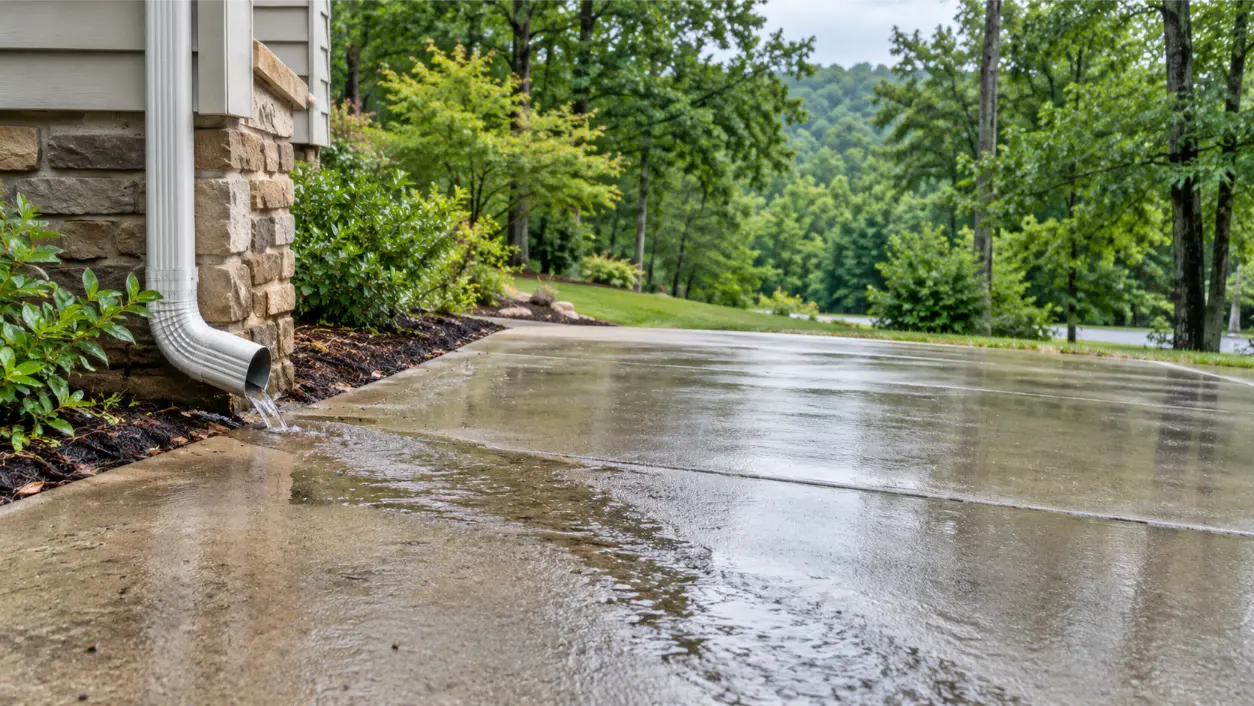

Downspout driveway damage can begin with something that looks harmless: rainwater spilling from a gutter outlet beside a concrete slab.
After each storm, the same area gets wet, leaves a dark streak, or develops a shallow channel in the soil. Over time, concentrated roof runoff may wash away support along a driveway edge, contribute to uneven settling, or send water toward the garage. The important question is not whether concrete can get wet. It is where the water goes, how much collects in one place, and what happens to the ground supporting the driveway.
For homeowners in Dahlonega, Gainesville, Cumming, Roswell, and other North Georgia communities, tracing that water path early can help separate a cleaning issue from a drainage or concrete problem that deserves a site evaluation.
Why a Downspout Creates More Concentrated Runoff Than Ordinary Rain
Rain falling directly on a driveway is spread across the surface. Gutters collect rainfall from a much larger roof area and direct it toward a few outlets. When one downspout ends beside concrete, water that landed across the roof can arrive in one small spot. The resulting flow can cross the driveway, follow a joint, or rush along the soil beside the slab.
Sound exterior concrete is designed to experience weather, so rain touching the slab does not automatically mean deterioration. The concern is repeated, concentrated discharge, especially when it hits bare soil, collects in an existing low area, or has no safe route away. The U.S. Department of Energy’s building-science guidance explains why roof water should be managed through gutters, downspouts, drainage paths, and appropriate grading rather than allowed to saturate vulnerable areas around a home.
Four Ways Downspout Runoff Can Affect a Concrete Driveway
1. Streaks, staining, and persistent damp patches
Water repeatedly crossing the same path can carry dirt, organic debris, and fine sediment onto concrete. That may leave dark flow marks, discolored bands, or damp patches that remain longer than surrounding surfaces. Shaded spots may also support biological growth where moisture persists. Staining is worth investigating, but it does not prove the slab has lost strength. First find out why that particular area remains wet.
2. Soil erosion along the driveway edge
If a downspout empties directly onto bare ground beside a driveway, a small channel can form as runoff carries away loose soil or mulch. The warning signs include exposed roots, missing soil at the concrete edge, sediment deposited farther downhill, and a groove that becomes deeper after successive storms. The problem is not necessarily erosion of the concrete itself: the water may be removing the material beside it.
3. Loss of support beneath the slab and uneven settling
A concrete driveway depends on reasonably consistent support from its base and the underlying ground. If runoff reaches an unprotected edge or opening and carries away supporting soil, a void or weakened area can develop. Vehicle loads and continued ground movement may then contribute to cracks, a lowered section, or a noticeable offset where slabs meet. Not every crack or sinking section comes from a downspout; compaction, tree roots, previous excavation, and other conditions can play a role. The pattern of erosion and drainage helps a qualified contractor evaluate the likely causes.
Gold City Construction’s guidance on why a driveway may sink on one side discusses soil support, runoff, and other possible contributors to uneven concrete. A careful inspection should distinguish these causes rather than assuming water is responsible for every defect.
4. Water collecting at joints, low spots, and garage approaches
Runoff can follow a driveway’s slope toward an expansion or control joint, settle in a depression, or approach a garage threshold. Standing water may make surfaces slippery and keep adjacent soil wet. Where temperatures drop below freezing, repeated wetting and freezing can contribute to deterioration under suitable conditions; it is not an automatic consequence of every winter rain. If the overall driveway slopes toward the garage, extending a downspout might reduce the incoming water but cannot correct the slab’s geometry by itself.
How to Tell Whether a Downspout Is Actually Part of the Problem
Start with observation rather than digging or immediately resurfacing the concrete. During a safe rain event, watch from a protected location to see where the outlet discharges and where the water travels. Avoid standing in lightning, rushing water, or unstable ground. After the storm, take photographs from the same angle and record what remains wet.
- At the outlet: Does water splash onto the slab, hit the lawn, or emerge from a pipe near the driveway?
- At the edge: Is soil missing, mulch displaced, or a small erosion channel visible beside the concrete?
- Across the surface: Does the flow follow a crack, joint, wheel path, or low spot?
- At the garage: Does runoff travel toward the door instead of a suitable drainage area?
- After the rain: Are puddles, sediment, widening cracks, or changes in slab height becoming more noticeable?
These observations are more useful than assuming a stain must be a concrete failure. If the outlet is blocked or overflowing at the gutter, the problem may begin higher on the home. If water appears well away from the roof outlet, uphill yard runoff or another source may also be involved.
Practical Ways to Redirect Downspout Water
Move discharge toward a suitable surface-drainage area
A properly planned downspout extension can sometimes carry roof water beyond a vulnerable driveway edge and release it onto a stable, appropriate area. The destination matters more than buying the longest available extension. Water should not simply be moved toward the home’s foundation, a neighbor’s property, a steep eroding slope, or an unsuitable public drainage connection. Final placement depends on the site, soils, grade, runoff volume, and local requirements.
Consider buried conveyance only with a workable outlet
For some properties, a drainage specialist may recommend buried piping or another conveyance route. Such systems need a suitable discharge point, enough fall or an engineered alternative, and provisions for maintenance. A pipe that terminates below grade without appropriate drainage can create another saturated area. Before excavation, review Georgia 811’s utility-locate process and identify any private utility lines that a standard locate may not mark.
Evaluate rain gardens, infiltration, or rainwater collection
Where property conditions permit, capturing or infiltrating roof runoff may reduce the amount crossing hardscape. The U.S. Environmental Protection Agency’s green-infrastructure overview describes downspout disconnection, rain gardens, and rainwater collection as ways to manage stormwater. These are site-dependent measures: unsuitable soil, steep terrain, insufficient separation from structures, or a poorly designed overflow route can make a particular approach inappropriate.
Review the driveway slope if roof-water routing is not enough
Sometimes the downspout adds water to a preexisting drainage defect. If a concrete section has settled or pitches toward the home, a channel drain, localized reconstruction, or driveway replacement may require consideration. Any drain needs a safe and functional outlet; installing a grate by itself does not resolve a bad discharge route. For a related example, see Gold City Construction’s article about driveways that drain toward the garage.
Why Cleaning or Sealing the Stain Is Not the Whole Fix
Cleaning can improve how a marked driveway looks, and a compatible treatment may be appropriate for some sound concrete surfaces. But neither addresses roof water repeatedly striking the same place. If the adjacent soil continues washing out, fresh surface treatment will not restore the missing support. Avoid aggressive cleaning methods that may damage weakened surfaces, and seek material-specific guidance before applying sealers.
Likewise, filling a crack before investigating ongoing movement may be only a short-term measure. The priority is to identify and correct the water source, then evaluate the extent of any concrete damage. A useful repair sequence treats the site and slab as connected parts of the same problem.
When Is a Small Correction Enough, and When Might Concrete Need Replacement?
A driveway with mainly superficial staining, sound edges, no visible movement, and a straightforward discharge problem may need better roof-water routing and appropriate cleaning rather than new concrete. Small stable defects may warrant repair after the underlying drainage issue is addressed. A professional should assess whether those conditions actually apply.
More extensive work may be appropriate when you see widespread cracking, crumbling edges, significant offsets between sections, recurring settlement, or drainage that the current slab layout cannot handle. Replacement can create an opportunity to review the base, the driveway’s finished elevations, and how runoff will leave the property. It should not be recommended automatically just because a downspout is nearby.
Gold City Construction provides concrete driveway installation, replacement, extensions, and residential flatwork. Its published approach includes reviewing existing conditions, drainage, access, layout, and homeowner needs before recommending a scope. Gutter repair or buried drainage design may require a qualified professional in the relevant trade; those are not services assumed to be part of every concrete estimate.
What North Georgia Homeowners Should Consider
North Georgia lots range from relatively level suburban properties to sloping sites with long approaches and drainage crossing different elevations. A downspout that appears harmless in light rain may produce a more obvious flow path during a heavier storm. Soils, landscaping, previous fill, nearby foundations, garage thresholds, and the driveway’s connection to the street can all affect the consequences. The same extension or trench detail will not work on every property.
Where proposed work involves excavation, homeowners and contractors should coordinate utility locating and check applicable local permit, easement, and drainage rules. Never redirect concentrated runoff into a neighboring property or road area without confirming that the arrangement is appropriate and allowed. An on-site assessment is especially important when the water is close to a foundation, retaining wall, garage, or steep slope.
Eight-Point Checklist for a Downspout Beside Your Driveway
- Find the outlet: Identify the gutter and downspout feeding the wet area.
- Trace the flow: Observe the route during safe rain conditions and after the storm.
- Photograph the pattern: Record stains, sediment, erosion channels, puddles, and slab offsets.
- Check the edge: Look for missing soil or gaps without probing under unsupported concrete.
- Look for other sources: Consider yard slopes, driveway pitch, and blocked gutter components.
- Plan a real outlet: Any extension, pipe, or collection system must have an appropriate destination.
- Check safety and permissions: Confirm utilities before excavation and review local drainage requirements.
- Review the concrete: Have a qualified contractor assess cracks, sinking, or drainage-related layout problems before choosing repair or replacement.
Frequently Asked Questions
Can a downspout draining onto concrete damage the driveway?
It can contribute to problems if the discharge is concentrated, repeatedly collects at a weak point, or erodes soil beside or beneath the slab. Ordinary rain on otherwise sound concrete is not automatically damaging. The discharge path and existing condition matter.
Are dark streaks from a downspout a sign of structural damage?
Not by themselves. Flowing water can leave sediment or moisture staining on sound concrete. Investigate further if you also see soil loss, sinking, widening cracks, standing water, or uneven joints.
Why is the driveway edge washing away near the gutter outlet?
Roof runoff may be hitting exposed soil and carrying fine material downhill. The severity depends on outlet location, ground cover, slope, and storm conditions. Have the discharge route and slab-edge support assessed if erosion continues.
Will a longer downspout extension fix driveway damage?
It may help reduce future exposure if it carries water to an appropriate destination. It will not lift a settled slab, repair cracks, or correct an improperly sloped driveway. The outlet location should be reviewed rather than chosen from a universal distance rule.
Should I install a drain across the driveway?
Only if site conditions justify it and the drain has a suitable, maintainable outlet. A channel drain may intercept runoff approaching a garage, but it cannot compensate for every slab or grading problem.
When should I request a concrete driveway estimate?
Consider an evaluation when runoff is accompanied by sinking, repeated puddling, widening cracks, crumbling edges, erosion beneath the slab, or water approaching the garage. A site visit can help determine whether drainage routing, concrete work, or both should be evaluated.
Address the Water Path Before It Becomes a Larger Driveway Problem
Trace where the downspout sends water and whether it is disturbing soil or concrete. Redirecting runoff may help protect sound pavement; significant settlement or poor grades can require broader work. Gold City Construction serves North Georgia homeowners, including Dahlonega, Gainesville, Cumming, Roswell, and North Atlanta. Explore its residential concrete services or request a free estimate to discuss the driveway, access, and drainage. The appropriate work depends on the property and may require a drainage specialist.
Disclaimer: This article provides general homeowner information about drainage and exterior concrete, not site-specific engineering, construction, legal, or safety advice. Erosion, settlement, drainage performance, utility locations, permits, and property-line discharge requirements vary. Have qualified professionals evaluate structural or drainage concerns and verify current local rules before excavation or construction.
RELATED LINK: U.S. Department of Energy — Foundation Drain Gutters Downspouts