
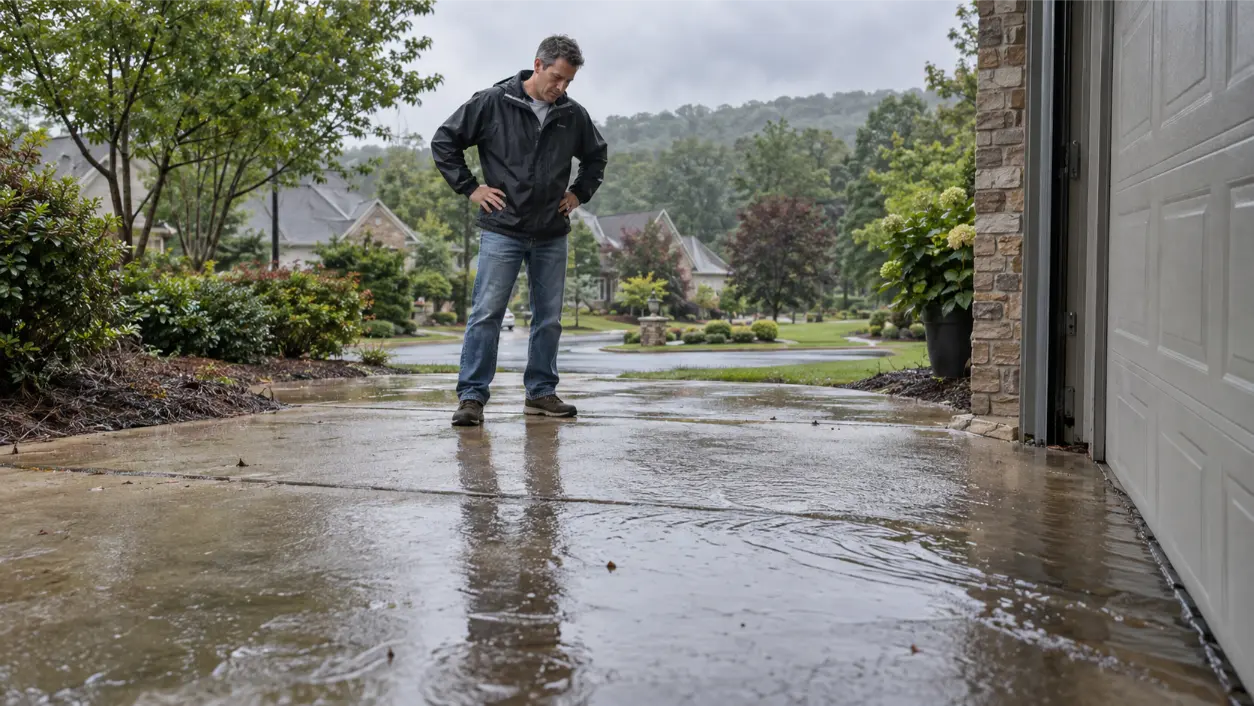


When a driveway drains toward garage doors, the problem is usually not the rain itself. The real issue is the path the water is given after it lands on the concrete. A driveway that pitches toward the house, a slab that has settled over time, a low spot near the garage, concentrated roof runoff, or a missing drainage intercept can all send water toward the threshold. For North Georgia homeowners, the right fix starts with identifying where the runoff is coming from and why it is moving toward the structure before choosing between regrading, concrete replacement, drainage improvements, or a combination of solutions.
Water Follows Grade, Even When the Problem Is Hard to See
Stormwater moves downhill across hard surfaces. UGA Cooperative Extension explains that driveways are impervious surfaces, so rainfall that cannot soak into the concrete becomes runoff and follows slope, surface shape, and drainage paths. A driveway can look almost flat to the eye while still having enough pitch to move water toward a garage door.
That is why visual inspection alone is not enough. A contractor may need to check elevations from the street or yard side toward the garage, identify where water crosses the driveway, and determine whether the surface has a continuous fall toward the house or only a localized depression near the threshold.
Cause 1: The Driveway Was Pitched Toward the House
Some drainage problems begin with the original layout. If the concrete was placed so the finished surface falls toward the garage rather than away from it or toward a safe side drainage path, stormwater naturally follows that grade. The effect becomes more obvious during heavy North Georgia storms because a larger volume of water reaches the same low point in a short period.
A small surface treatment usually cannot correct a driveway whose overall geometry is wrong. When the main slab consistently directs water toward the structure, the solution may require removing and replacing part of the driveway so the finished elevations create a better drainage path. The exact slope and tie-in elevations should be determined from the property, garage threshold, street connection, drainage route, and local requirements rather than from a universal rule.
Cause 2: Concrete Settled After Installation
A driveway can drain correctly when new and develop problems years later if one or more sections settle. Soil movement, poor support, erosion, washout, or changes around the slab can create a low area that was not part of the original design. Once a section near the garage drops, water can begin collecting there or crossing the threshold even if the rest of the driveway still looks normal.
Signs Settlement May Be Part of the Problem
- A visible height difference between adjacent concrete sections.
- Cracks accompanied by one side of the slab sitting lower than the other.
- A puddle that forms in the same location after nearly every storm.
- Water that did not reach the garage in the past but does now.
- Erosion or voids along the slab edge.
- A low section directly in front of one garage bay while the rest of the driveway drains normally.
The key distinction is whether the drainage problem comes from the entire driveway slope or from a smaller settled section. Those situations can require different repairs.
Cause 3: A Low Spot Forms at the Garage Approach
Sometimes the driveway does not continuously slope toward the house. Instead, water reaches a shallow depression just before the garage. That low spot can behave like a basin: runoff enters faster than it can escape, then rises against the threshold.
Low spots can result from settlement, poor finishing, transitions between old and new concrete, or grade changes near the garage apron. During a site review, it helps to observe the driveway while wet or immediately after rain because the water itself traces the problem area.
Cause 4: Downspouts Add Water to the Driveway
Roof drainage can make a driveway problem much worse. A downspout that empties onto the uphill side of the concrete can add concentrated roof runoff to the water already falling on the driveway. UGA stormwater guidance emphasizes observing where water moves from roofs and paved surfaces and redirecting it into appropriate landscape or drainage systems when practical.
Before altering the driveway, check where nearby gutters and downspouts discharge. Moving or extending a downspout may reduce the volume reaching the garage, although it will not solve an incorrectly sloped or settled slab by itself.
Cause 5: There Is No Intercept Drain Before the Garage
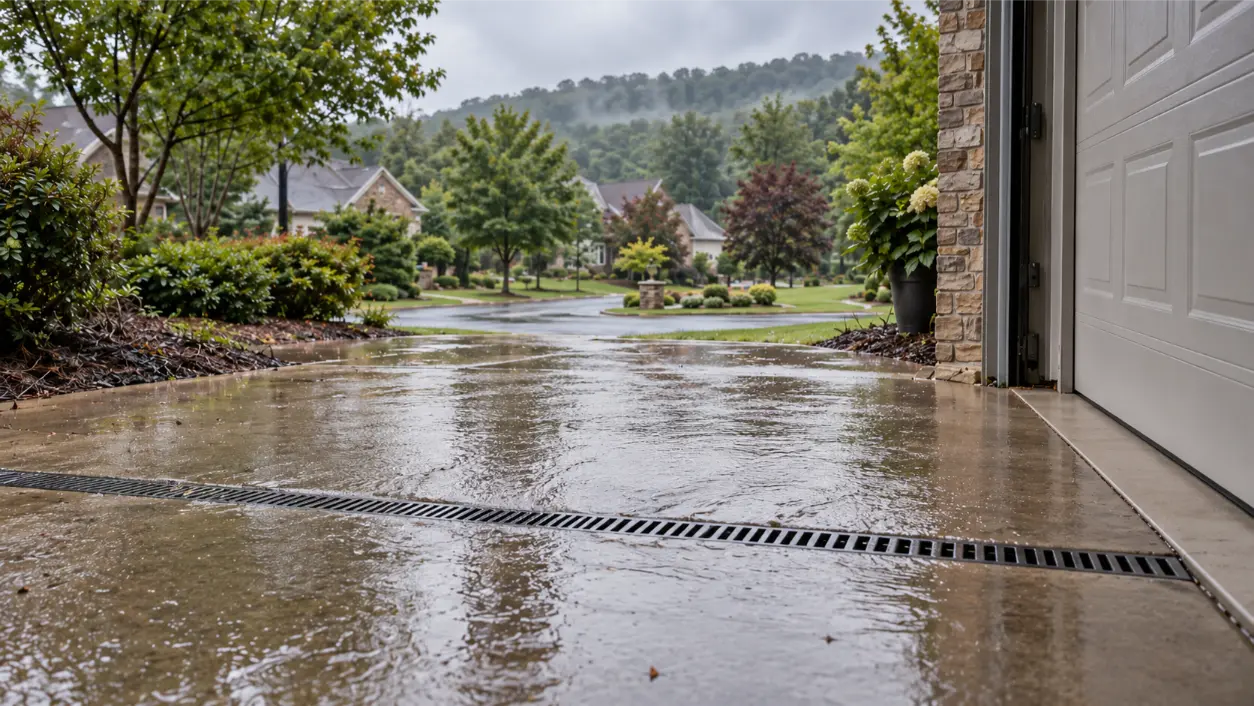
When site conditions make it difficult to create enough surface fall away from the garage, a linear channel drain can sometimes intercept water before it reaches the door. NDS, a drainage-system manufacturer, describes channel drains as linear surface drains used on driveways to capture sheet runoff and direct it through an outlet to a safe discharge location.
The important word is system. A grate across the driveway is not useful if it has nowhere appropriate to send the water. The drain location, capacity, outlet, pipe slope, vehicle load rating, maintenance access, and final discharge point all have to work together.
When a Channel Drain Can Be a Good Fit
- The driveway generally works but sheet flow approaches the garage during storms.
- There is a practical location to intercept water before it reaches the threshold.
- A safe, legal discharge point can be established.
- The drain can be integrated into concrete that carries vehicle traffic with the correct load-rated components.
- The system can be cleaned and maintained so leaves, sediment, and debris do not block the grate or outlet.
Manufacturer guidance commonly places a channel drain perpendicular to the water flow, near the low point or before runoff reaches a vulnerable area such as a garage. Final design still needs to account for actual rainfall, contributing drainage area, outlet elevation, and local stormwater rules.
When a Drain Alone May Not Solve the Problem
A channel drain should not be used to hide a major grade or structural problem without understanding the cause. If large portions of the driveway have settled, if water ponds in several locations, or if the slab is badly cracked and uneven, replacing the affected concrete may provide a more durable way to correct both the surface and the drainage path.
Likewise, a drain cannot work by gravity if the outlet is too high or if the discharge route simply sends water toward another vulnerable area. The solution should protect the garage without transferring the problem to the foundation, neighbor, slope, or public right-of-way.
How Concrete Replacement Can Correct Drainage
When deteriorated or settled concrete is already due for replacement, the new work creates an opportunity to reset elevations. Gold City Construction currently provides concrete driveway installation, replacement, extensions, and flatwork and says its planning process reviews existing conditions, access, drainage, layout, and homeowner goals before recommending a project scope.
During replacement, the contractor can evaluate how the new section should connect to the garage threshold, remaining driveway, surrounding grade, and drainage outlet. Site preparation and base conditions matter because the new slope only remains useful if the slab is properly supported for the property conditions.
Do Not Forget the Garage Threshold and Foundation Area
Repeated runoff at the garage door is more than an inconvenience. Water crossing the threshold can wet stored items, damage finishes, create slippery surfaces, and keep the slab edge damp. Runoff concentrated near the house can also contribute to moisture and erosion concerns around the structure.
If water is already entering the garage, inspect the door seal and threshold as part of the response, but do not rely on a taller seal as the primary drainage fix. The better long-term goal is to keep runoff from reaching the door whenever site conditions allow.
A Practical Diagnostic Checklist After the Next Storm
- Watch where water first enters the driveway.
- Check whether roof downspouts discharge onto or beside the concrete.
- Mark the point where runoff changes direction toward the garage.
- Photograph puddles and flow paths before the water evaporates.
- Look for settled slabs, cracks with vertical displacement, and low edges.
- Check whether one garage bay is affected more than the others.
- Observe whether water crosses the threshold or only ponds outside.
- Identify where water could safely discharge if a drain is added.
- Check for leaves, sediment, or debris in any existing drain.
- Ask whether local permits, right-of-way rules, or stormwater requirements affect the proposed work.
- Have driveway elevations checked before deciding that a drain alone will solve the issue.
- Compare the condition of the concrete with the cost and scope of drainage-only work versus replacement.
How Gold City Construction Fits the Project
Gold City Construction provides residential concrete driveway installation, replacement, extensions, and flatwork for homeowners across North Georgia, including Dahlonega, Dawsonville, Gainesville, Cumming, Alpharetta, Milton, Canton, Woodstock, Roswell, North Atlanta, and nearby communities.
If runoff is reaching your garage, review the company’s concrete driveway services to see the types of projects it handles. For a site-specific review of the existing concrete, grade, drainage path, and garage approach, you can request a free estimate.
FAQ: Driveway Water Running Toward the Garage
Why Is Rainwater Running Into My Garage From the Driveway?
Common causes include a driveway pitched toward the house, settled concrete, a low spot at the garage approach, roof runoff discharged onto the driveway, or inadequate surface drainage. More than one cause can be present at the same property.
Can a Channel Drain Stop Water From Entering a Garage?
It can be effective when it is correctly placed to intercept runoff and connected to an appropriate outlet. The drain has to be sized, supported, and discharged correctly for the site; adding a grate without a workable outlet will not solve the problem.
Should I Replace the Driveway if It Slopes Toward the House?
Replacement may be appropriate when the overall slab geometry is wrong, sections have settled significantly, or the concrete is already deteriorated. A site evaluation can determine whether a smaller repair, drainage system, partial replacement, or larger replacement makes more sense.
Can I Fix the Problem by Raising the Garage Door Seal?
A threshold or seal may help with minor splash or wind-driven water, but it does not correct runoff that is being directed toward the garage. The primary drainage path should be addressed.
Where Should Driveway Water Be Redirected?
The discharge point depends on the property and local rules. Water should be directed to an appropriate drainage area or approved system without creating erosion, foundation problems, neighbor impacts, or prohibited discharge into a public right-of-way.
The Bottom Line
When a driveway sends water toward the garage, start by diagnosing the grade rather than jumping directly to a drain. Determine whether the whole driveway slopes the wrong way, whether a section has settled, whether a low spot has formed, and whether roof runoff is adding volume. Then decide whether the best solution is regrading through concrete replacement, intercepting runoff with a channel drain, redirecting roof water, or combining several measures.
For North Georgia homeowners, the most reliable fix is the one that creates a complete drainage path from where the rain lands to where it can safely leave the property. That requires looking at the driveway, garage threshold, surrounding grade, outlet elevation, and existing concrete as one system.
Disclaimer: This article provides general residential-construction and drainage information, not engineering, waterproofing, legal, permitting, or site-design advice. Concrete grades, drainage capacity, outlet locations, stormwater rules, soil conditions, foundation details, and repair methods vary by property and jurisdiction. Obtain site-specific professional guidance before construction or drainage modifications.
Official and Technical Resources
- UGA Cooperative Extension – Urban Storm Water Management in Georgia
- U.S. EPA – Urbanization and Stormwater Runoff
- NDS – Channel Drain Installation Guide
RELATED LINK: UGA Cooperative Extension – Urban Storm Water Management in Georgia